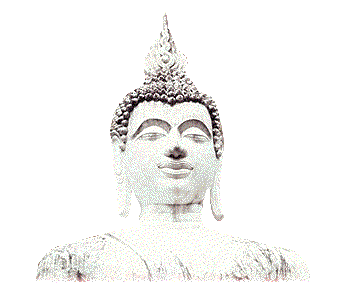
A Manual Of Buddhism
By
Venerable Narada Maha Thera
Published by the Buddhist Missionary Society, 1992
Buddhist
Vihara
123, Jalan Berhala
50470 Kuala Lumpur, Malaysia
About This
Book
This is a fairly comprehensive book enabling the reader to appreciate
and understand certain important finer aspects of Theravada Buddhism. This book
would also serve as a reference, for both Teachers and Students alike, gain a
good insight into the fundamentals of Buddhism.
The author, the late Venerable
Narada Maha Thera was a well-known Buddhist Missioner. He is also the author of
many other Buddhist Publications. We are grateful to him for his kind permission,
enabling; this reprint to be effected in Malaysia.
Special thanks are due to
Ven. U. Nipuna Mr. Tan Teik Beng, Mr. Eddy Yu Chen Lim, Ms. Quah Pin Pin and Ms.
Chong Hong Choo for their valuable assistance in the reproduction of this book.
K.
SRI DHAMMANANDA J.S.M.
Buddhist Missionary Society
Buddhist Vihara, Jalan
Berhala,
50470 Kuala Lumpur, Malaysia
September,1992
Chapter 1
The
Life Of The Buddha
The Birth
On the full-moon day of May in the year 623
B.C. there was born, in the Lumbini Park at Kapilavatthu, on the borders of Nepal,
a noble Prince of aristocratic Sakya clan. His father was King Suddhodana and
his mother Queen Maha Maya. Seven days after the birth of the child, the mother
died, and Maha Pajapati Gotami, her younger sister, who was also married to King
Suddhodana, became his foster mother.
Great was the rejoicing of the people
over the birth of this illustrious prince. A certain ascetic, named Asita, also
known as Kaladevala, was particularly pleased to hear this happy news and, being
a tutor of the King, visited the palace to see the royal baby. The overjoyed King
brought the child, to pay him due reverence, but, to the surprise of all, his
feet turned and planted themselves in the matted locks of the ascetic. Instantly
the ascetic rose from his seat and foreseeing the child's future greatness, saluted
him with joined hands. When he thus honored him, the royal father too saluted
him in the same way.
The great ascetic at first smiled and then was sad. Questioned
as to his mixed feelings, he replied that he smiled because the Prince would,
eventually become a Buddha; and that he was sad because he, owing to his prior
death and rebirth in a Formless Plane - Arupaloka, could not benefit by the superior
wisdom of the Enlightened One.
The Naming Ceremony
On the fifth day after
the Prince's birth, he was named Siddhattha Gotama, which means 'wish fulfilled'.
His family name was Gotama.' In accordance with the ancient custom, many learned
Brahmins were invited to the palace for this naming ceremony. Amongst them were
eight distinguished men. Examining the characteristics of the child, seven of
them raised two fingers and gave a double interpretation, saying that he would
either become a Universal Monarch or a Buddha.
But the youngest Kondanna, who
excelled the others in knowledge, raised only one finger and firmly declared that
he would definitely retire from the world and become a Buddha.
The Plowing
Festival
A very remarkable incident took place in his childhood. It was an
unprecedented mental experience, which, in later life, during his search for Truth,
served as a key to his Enlightenment. As an encouragement to agriculture the King
arranged for a Plowing Festival. It was indeed a festive occasion for all, as
both nobles and commoners decked in gala dress participated in the ceremony.
On
the appointed day the King, accompanied by his courtiers, went to the field taking
with him, the young Prince together with the nurses. Placing the child on a screened
and canopied couch under the cool shade of a rose-apple tree to be watched by
the nurses, the King took an active part in the Plowing Festival.
When the
festival was at its climax, the nurses stole away from the Prince's presence to
catch a glimpse of the wonderful spectacle. The thoughtful child, mature in intellect
though young in age, seeing none by him, sat cross-legged, and intently concentrating
on inhalation and exhalation, gained one-pointed-ness of the mind and developed
the First Ecstasy - Jhana.
In the midst of their enjoyment the neglectful nurses
suddenly remembered their duty, and when they saw the Prince absorbed in meditation,
were struck with awe and immediately reported the matter to the King. He hastened
to the scene and beholding the Prince in meditative posture, saluted him saying:
"This, dear child is my second salutation."
Prince Siddhattha's Youth
As
a royal child Prince Siddhattha no doubt received a good education, although the
books give no details about his schooling. Being a scion of the warrior race,
he must have been specially trained in the art of warfare.
At the early age
of sixteen, he married his beautiful cousin Princess Yasodhara who was of equal
years. After his happy marriage, he led a luxurious life, blissfully unaware of
the vicissitudes of life, outside the palace gates.
Of his luxurious life as
a prince he states: -"I was delicate, excessively delicate. In my father's
dwelling three lotus ponds were made purposely for me. Blue lotuses bloomed in
one, red in another, and white in the third. I used no sandalwood that was not
of Kasi. My turban, tunic, dress and cloak were all from Kasi. Night and day a
white parasol was held over me so that I might not be touched by heat or cold,
dust, leaves or dew."
"There were three palaces built for me - one
for the cold season, one for the hot season, one for the rainy season. During
the four rainy months, I lived in the palace for the rainy season, entertained
by female musicians, without coming down from the palace. Just as in the houses
of others, food from the husks of rice together with sour gruel is given to the
slaves and workmen, even so, in my father's dwelling, food with rice and meat
was given to the slaves and workmen."
Renunciation
With the march of
time truth gradually dawned upon him. His contemplative nature and boundless compassion
did not permit him to enjoy the fleeting pleasures of a royal household. He knew
no woe, but he felt deep pity for sorrowing humanity. Amidst comfort arid prosperity
he realized the universality of sorrow.
One glorious day, as he went out of
the palace to see the world outside, he came into direct contact with the stark
realities of life. Within the narrow confines of the palaces, he saw only the
rosy side of life; but the dark side, the common lot of mankind was veiled from
him. His observant eyes met the strange sight of a decrepit old man, a diseased
person, a corpse, and a dignified hermit.
The first three sights convinced
him of the inexorable nature of life and the universal sickness of humanity. The
fourth signified the means to overcome the ills of life and attain calm and peace.
Realizing the worthlessness of sensual pleasures highly prized by ordinary men,
and the value of renunciation in which the wise seek delight, he decided to leave
the world in search of Truth and Peace.
When this final decision was made after
much deliberation, the seemingly happy news of the birth of a son was conveyed
to him. Contrary to expectation he was not overjoyed but regarded the first and
only offspring as an impediment. Normally an ordinary father would have welcomed
the joyful tidings, but Prince Siddhattha, extra-ordinary father as he was, exclaimed,
"An impediment - rahu, has been born; a fetter has arisen". The infant
son was accordingly named Rahula by his grandfather.
The palace was no longer
a congenial place for the destined Buddha. The time was ripe for him to depart.
He
ordered his favorite charioteer Channa to saddle the horse Kanthaka, and went
to the suite of apartments occupied by the Princess. Opening the door of the chamber,
he stood on the threshold and cast his dispassionate glance on the wife and child
who were fast asleep. His compassion for his two dear ones as well as for the
whole world dominated him at the moment of parting. He was not worried about the
future worldly comforts and happinesses of the mother and child as they had everything
in abundance and were well protected.
Leaving all behind with a light heart,
he stole away from the palace at midnight and rode into the dark on his horse,
attended only by his loyal charioteer. As a penniless wanderer he went forth in
search of Truth and Peace.
It was in his twenty-ninth year, the turning point
of his career, that Prince Siddhattha made this historic journey. He journeyed
far, and crossing the river Anoma, rested on the bank. Here he shaved his hair
and beard and, handing over his garments and ornaments to Channa with instructions
to return to the palace, adopted the simple yellow garb of an ascetic and led
a life of voluntary poverty. The ascetic Siddhattha, who as a Prince had lived
in the lap of luxury, became a penniless and homeless wanderer living on what
little the charitable gave of their own accord.
He had no permanent abode.
A shady tree or a lonely cave sheltered him day and night. Barefooted and bareheaded,
he walked in the scorching sun and in the piercing cold. His humble dress was
made of cast-off, worthless, coarse rags.
With no possession to call his own
except a bowl to collect his food and robes just sufficient to cover the body,
he concentrated all his time and energies upon discovering the Truth.
The Search
As
a seeker after what is good (kim kusalagavesi) searching for the unsurpassed peaceful
state most excellent, he approached Alara Kalama an ascetic of repute, and speedily
learnt his doctrine and developed the seventh Arupa Jhana, the Realm of Nothingness,
(Akincannayatana), an advanced stage of concentration.
The un-envious teacher,
delighted to hear of the success of his distinguished pupil, honored him by placing
him on a level with himself and admiringly said:-
"Happy, friend, are
we; yea, extremely happy, in that we look up to a respected ascetic like you!
The doctrine, which I know, that also do you know; and the doctrine, which you
know, that I know also. As I am, so are you; as you are, so am I. Come, friend,
let both of us lead the company of ascetics."
The ascetic Gotama was not
satisfied with mere mental concentration and an ordinary system, which did not
lead to Nibbána. Dissatisfied with Kalama's system, he left him, and approached
one Uddaka Ramaputta, who readily admitted him as a pupil.
Before long the
intelligent ascetic Gotama mastered his doctrine and attained the final stage
of mental concentration, The Realm of Neither Perception nor Non-perception -
Neva sañña nasannayatana. This is the highest stage in worldly concentration
when consciousness becomes so subtle and refined that it cannot be said that a
consciousness either exists or not. Ancient sages could not proceed any further
in mental development.
His teacher then honored the ascetic Gotama further
by inviting him to take full charge of all disciples as their teacher. He said:-
"Happy,
friend, are we; yea, extremely happy in that we see such a venerable ascetic as
you! The doctrine, which Rama knew, you know; the doctrine, which you know, Rama
knew. As was Rama, so are you; as you are, so was Rama. Come, friend, henceforth
you shall lead this company of ascetics."
Still he felt that his quest
of life was not achieved. He was seeking Nibbána, the complete cessation
of suffering. Dissatisfied with Ramapuna's system too, he departed. He found that
nobody was competent to teach him what he sought as all were enmeshed in ignorance.
He gave up seeking external help, for Truth and Peace are to be found within.
His
Struggle For Enlightenment
Meeting with disappointment but not discouraged,
the ascetic Gotama, seeking for the incomparable state of Peace Supreme, wandered
in the district of Magadha and arrived in due course at Uruvela, the market town
of Senani. There he spied a lovely spot of ground, a charming forest grove, a
flowing river with pleasant sandy fords, and near by was a village where he could
beg for his food.
The place was congenial for his meditation. The atmosphere
was peaceful, the surroundings were pleasant, the scenery charming. He resolved
to settle down there alone to achieve his desired object.
Hearing of his renunciation
Kondanna, the youngest Brahmin who predicted his future, and four sons of the
other sages - Bhaddiya, Vappa, Mahanama, and Assaji - also renounced the world,
and joined his company.
In ancient India great importance was attached to rites,
ceremonies, penances, and sacrifices. It was then a popular belief that no salvation
could be gained unless one led a life of strict asceticism. Accordingly for six
long years he made a super-human struggle practicing all forms of severe austerity,
with the result that his delicate body was reduced almost to a skeleton. The more
he tormented his body, the farther his goal receded from him.
Temptation Of
Mara The Evil One
His prolonged painful austerities proved utterly futile.
They only resulted in the exhaustion of his energy. Though physically a superman,
on account of his delicate nurture as a prince, he could not possibly stand the
great strain. His graceful form faded almost beyond recognition. His golden-colored
skin turned pale, blood dried up, sinews and muscles shriveled, and his eyes were
sunk and blurred.
At this critical stage, Mara approached the ascetic Gotama
and said:-
"You are lean and deformed. Near to you is death. A thousand
parts (of you belong) to death; to life (there remains) but one. Live, O good
sir; life is better. Living you could perform merit. By leading a life of celibacy
and making fire sacrifices, much merit could be acquired. What will you do with
this striving? Hard is the path of striving, difficult and not easily accomplished."
He
replied:
"O Evil One, kinsman of the heedless! You have come here for
your own sake. Even an iota of merit is of no avail. To them who are in need of
merit it behooves you, Mara, to speak thus. Confidence - Saddha, self-control
- Tapo, energy-Viriya, and wisdom - Paññá are mine. Why do
you question me, who am thus intent, about life?"
"Even the streams
of rivers will this wind dry up. Why should not the blood of one who is thus striving
dry up? When the blood dries up, the bile and phlegm also dry up. When my flesh
wastes away, more and more does my mind get clarified. Still more do my mindfulness,
wisdom, and concentration become firm."
"While I live thus, experiencing
the utmost pain, my mind does not long for lust. Behold the purity of a being!"
Sense-desires
- Kama, is your first enemy,
The second is called Aversion - Arati,
The
third is Hunger and Thirst- Khuppipasa,
The fourth is called Craving- Tanha,
The
fifth is Sloth and Torpor- Thina-Middha,
The sixth is called Fear- Bhaya,
The
seventh is Doubt - Vicikiccha, and
The eighth is Detraction and Obstinacy-
Makkha-Thambha,
The ninth is Profit - Labha, Praise- Siloka, Honour- Sakkara,
and that ill-gotten Fame-Yasa.
The tenth is the extolling of oneself and the
contempt of others.
"This is your army, the opposing host of the Evil
One. That army the coward does not over-come, but he who overcomes obtains happiness."
"This
Munja do I display! What boots life in this world! Better for me is death in the
battle than that one should live on, vanquished!". With these words the ascetic
Gotama dismissed Mara and made a firm determination to attain his goal, Buddhahood.
The
Middle Path
The ascetic Gotama was now fully convinced, through personal experience,
of the utter futility of self-mortification. Abandoning it forever, he adopted
an independent course - the Majjhima Patipada - the Middle Path.
He recalled
how when his father was engaged in plowing, he sat in the cool shade of the rose-apple
tree, having attained to the first Ecstasy. He thought - well, this is the Path
to Enlightenment!
He realized that Enlightenment could not be gained with an
exhausted body. So he decided to take some food. The five ascetics who attended
on him, disappointed at this unexpected change of method, deserted him and went
to Isipatana, saying that "the ascetic Gotama had become indulgent, had ceased
from striving, and had returned to a life of comfort."
At a crucial time
when help would have been most welcome, his only companions left him, but he was
not discouraged. After a substantial meal offered by Sujata, a generous lady,
he made a firm resolve not to rise from his seat until he attained Buddhahood.
The
Enlightenment
One happy Vesak night, as he was seated under the famous Pippala
tree at Buddha Gaya, with mind tranquillized and purified, in the first watch
he developed that supernormal knowledge which enabled him to remember his past
lives Pubbenivasanussati Nana - Reminiscence of Past Births. In the middle watch
he developed the clairvoyant supernormal vision dealing with the death and rebirth
of beings Cutupapata Nana - Perception of the Disappearing and Reappearing of
Beings.
In the last watch of the night he developed the supernormal knowledge
with regard to the destruction of passions - Asavakkhaya Nana, and comprehending
things as they truly are, attained Perfect Enlightenment - Samma Sambodhi.
Having
in his 35th year attained Buddhahood, that supreme state of Perfection, He devoted
the remainder of that precious life to serve humanity both by example and precept,
dominated by no personal motive.
The Buddha was a human being. As a man He
was born, as a man He lived, and as a man His life came to an end. Though human,
He became an extraordinary man - Acchariya Manussa. The Buddha laid stress on
this fact and left no room for anyone to fall into the error of thinking that
He was an immortal being. There is no deification in the case of the Buddha.
Nor
does the Buddha claim to be an incarnation of Vishnu, nor does He call himself
a "Savior" who freely saves others by His personal salvation. The Buddha
exhorts His disciples to depend on themselves for their salvation, for both defilement
and purity depend on oneself.
"You yourselves should make the exertion.
The Tathágatas are only teachers," says the Buddha. The Buddhas point
out the path, and it is left for us to follow that path to save ourselves.
"To
depend on others for salvation is negative, but to depend on oneself is positive."
Dependence on others means a surrender of one's effort. Furthermore, the Buddha
does not claim a monopoly of Buddhahood, which as matter of fact is not the prerogative
of any specially graced, chosen person. He reached the highest possible state
of perfection any person could aspire to; and without the closed fist of a teacher,
He revealed the only straight path that leads thereto.
According to the teachings
of the Buddha anybody may aspire to that supreme state of perfection if he makes
the necessary aspiring determination and necessary exertion. As a man He attained
Buddhahood and proclaimed to the world the latent possibilities and the creative
power of man. Instead of placing an unseen almighty God over man, and making him
subservient to such a belief, He raised the worth of mankind.
It was He who
taught that man could obtain his Deliverance from sorrow by his own exertion,
without depending on a God and mediating priests or on sacrifices and prayers.
It was He who taught the egocentric world the noble ideal of selfless service.
It was He who revolted against the degrading caste system and taught the equality
of mankind. He declared that the gates of success and prosperity were open to
all, in every condition of life, high and low, saint and sinner, who would care
to turn over a new leaf and aspire to Perfection.
Irrespective of caste, color
or rank, he established for both deserving men and women a celibate order, which
was "democratic in constitution and communistic in distribution." He
gave complete freedom of thought and wanted us to open our eyes to see things
as they truly are. He comforted the bereaved by His consoling words.
He ministered
to the sick that were deserted. He helped the poor who were neglected.
He ennobled
the lives of sinners and purified the corrupted lives of criminals. He encouraged
the feeble, united the divided, enlightened the ignorant, clarified the mystic,
guided the deluded, elevated the base, and dignified the noble. Rich and poor,
saint and sinner, loved Him alike. Despotic and righteous kings, glorious and
obscure princes and nobles, generous and miserly millionaires, haughty and humble
scholars, destitute paupers, downtrodden scavengers, wicked murderers, despised
courtesans all benefited by His words of wisdom and compassion.
His noble example
was a source of inspiration to all. His Message of Peace was hailed by all with
indescribable joy, and was of eternal benefit to everyone who had the fortune
to come under its benign influence.
Soon After The Enlightenment:
A Paean
of Joy - Udana Gatha
Thro' many a birth in Samsara wandered I,
Seeking but
not finding, the builder of this house.
Sorrowful is repeated birth.
O house-builder!
Thou art seen.
Thou shalt build no house again,
All thy rafters are broken,
thy
ridge-pole is shattered.
The Mind attains the Unconditioned.
Achieved is
the End of Craving.
Dhammapada w. 153, 154
The Seven Weeks after the Enlightenment
On
the auspicious day preceding the Enlightenment, the Bodhisatta ate some milk-porridge
offered by a generous lady named Sujata. After the Enlightenment for seven weeks
the Buddha fasted, and spent His time under the Bodhi tree and in its neighborhood.
The
whole of the first week the Buddha sat under the Bodhi tree in one posture, experiencing
the Bliss of Emancipation - Vimutti Sukha.
At the end of the seven days the
Buddha emerged from that state of concentration, and in the first watch of the
nights thoroughly reflected on Dependent Arising - Paticca Samuppada, in direct
order thus: When this (cause) exists, this (effect) is; with the arising of this
(cause), this (effect) arises. In the middle watch of the night the Buddha thoroughly
reflected on "Dependent Arising" in reverse order thus: "When this
(cause) does not exist, this (effect) is not; with the cessation of this (cause),
this (effect) ceases."
In the third watch of the night the Buddha reflected
on "Dependent Arising" in direct and reverse order thus:- "When
this (cause) exists, this (effect) is, with the arising of this (cause) this (effect)
arises; when this (cause) does not exist this (effect) is not; with the cessation
of this (cause), this (effect) ceases." Throughout the second week, as a
mark of gratitude to the Bodhi tree that sheltered Him during His struggle for
Enlightenment, the Buddha stood gazing at it with motionless eyes. During the
third week the Buddha paced up and down on a jeweled promenade - Ratana Cankamana
near the Bodhi tree.
The fourth week He spent in a jeweled chamber" -
Ratanaghara meditating on the Abhidhamma. During the fifth week He dwelt under
the Ajapala Banyan tree in the vicinity of the Bodhi tree. Here the Buddha sat
in one posture for seven days enjoying this Bliss of Emancipation. When He emerged
from that state of concentration, a certain conceited Brahmin approached the Buddha
and questioned Him thus:-"In what respect, O Venerable Gotama, does one become
a Brahmin, and what are the conditions that make a Brahmin?"
Then the
Blessed One uttered this paean of joy: -
"That Brahmin who has discarded
evil, without conceit - huhunka, free from defilements, self-controlled, versed
in knowledge, who has led the Holy Life - rightly would call himself a Brahmin.
For him there is no elation anywhere in this world." According to the Jataka
Commentary it was during His stay at the foot of this tree that the three daughters
of Mara - Tanha, Arati, and Raga - came to tempt the Buddha.
From the Ajapala
Banyan tree the Buddha proceeded to the Mucalinda tree where He spent the sixth
week. Here, too, the Buddha sat for seven days enjoying the Bliss of Emancipation.
At that time there arose an unexpected great shower. Rain and gloomy weather with
cold winds prevailed for seven days.
Thereupon Mucalinda, the serpent-king,
came out of his abode and coiling round the body of the Blessed One seven times,
remained keeping his large hood over the head of the Blessed One so that the Blessed
One may not be touched by cold, heat, gadflies, gnats, wind, sun or reptiles.
At
the close of seven days Mucalinda seeing the clear, cloudless sky, uncoiled himself
from around the body of the Blessed One, and leaving his own form, took the guise
of a young man, and stood in front of the Blessed One with joined hands.
Thereupon
the Buddha uttered this paean of joy: "Happy is seclusion to him who is contented,
to him who has heard the Truth, and to him who sees. Happy is goodwill in this
world, and so is restraint towards all beings. Happy in this world, is non-attachment,
the passing beyond sense-desires. The suppression of the 'I am' conceit is indeed
the highest happiness."
The seventh week the Buddha spent at the Rajayatana
tree. Here too the Buddha sat in one posture for seven days enjoying the Bliss
of Emancipation.
The First Two Converts
At that time two merchants, Tapassu
and Bhalluka, trom Ukkala (Orissa) were traveling to their native town. Then a
Devata's who was a blood-relative of these two merchants, spoke to them as follows:
- "The Blessed One, good sirs, is dwelling at the foot of the Rajayatana
tree, soon after His Enlightenment. Go and serve the Blessed One with flour and
honeycomb. It will conduce to your well-being and happiness for a long time."
Thereupon
the two merchants, Tapassu and Bhalluka, took with them flour and honeycomb, and
approaching the Buddha said: -
"O Lord, may the Blessed One accept this
flour and honeycomb so that it may long tend to our well-being and happiness!"
Then it occurred to the Blessed One: "The Tathágatas do not accept
food with their hands. How shall I accept this flour and honeycomb?"
Forthwith
the tour Great Kings understood the thoughts of the Blessed One and from the four
directions offered Him four stone bowls, saying: -
"O Lord may the Blessed
One accept in these the flour and honeycomb!"
The Blessed One accepted
the new bowls, received the flour and honeycomb in them, and ate thereof.
When
the Buddha finished His meal the two merchants prostrated themselves before His
feet and said:-
"We, O Lord, seek refuge in the Buddha and the Dhamma.
May the Blessed One treat us as lay disciples who have sought refuge from today
till death!"
They were the first disciples who took the twofold formula."
Chapter
3
The Buddha Propounds His Dhamma
Invitation To Teach The Dhamma
The
close of the fasting period, as the Buddha was engaged in solitary meditation,
He thought: -
"With difficulty have I apprehended the Dhamma. There is
no need to proclaim it now. This Dhamma is not easily understood by those who
are overcome by lust and hatred. The lust-ridden, shrouded by the mass darkness,
do not see this Dhamma, which goes against the stream, abstruse, profound, difficult
to perceive, and subtle."
Eventually His mind turned into inaction, and
not to the teaching of the Dhamma.
Thereupon a celestial being named Brahma
Sahampati read the thoughts of the Blessed One, and fearing that the world might
perish through not hearing the Dhamma, approached the Buddha and invited Him to
teach the Dhamma.
He wisely remarked:
"In ancient times there arose
in Magadha a Dhamma, impure, evolved by the corrupted. Open this Door to the Deathless.
May they hear the Dhamma, understood by the Stainless! Just as one standing on
the summit of a rocky mountain would behold the people around, even so may the
All-Seeing Wise One ascend this palace of Dhamma!
May the Sorrow less One look
upon the people, plunged in grief and overcome by birth and decay."
"Rise,
O Hero, the victor in battle, the caravan-leader, the debt-free One, and wander
in the world! May the Blessed One propound the Dhamma! There will be those who
will understand the Doctrine!"
When Brahma Sahampati entreated the Buddha
for the third time, He surveyed the world with His Buddha Vision.
On surveying
the world He perceived beings with little as well as much dust in their eyes,
with keen and dull intellect, with good and bad characteristics, who are easy
and difficult to be taught, and a few others who live perceiving the dangers of
evil and of a future life.
The Buddha, therefore, accepted the invitation of
Brahma Sahampati and said:
"Opened to them are the Doors to the Deathless.
Let those who have ears repose confidence. Being aware of the weariness of it,
O Brahma, I did not preach amongst men this glorious and excellent Dhamma."
The
delighted Brahma, thinking - "I made myself the occasion for the Blessed
One to expound the Dhamma," respectfully saluted Him and straightaway disappeared.
On
the Way to Benares to Teach the Dhamma
"To whom shall I teach the Dhamma
first? Who will understand the Dhamma quickly?" was the first thought that
occurred to the Buddha before He embarked on His noble Mission.
"Well,
there is Alara Kalama, who is learned, clever, wise, and has for long been with
little dust in his eyes. How if I were to teach the Dhamma to him first? He will
understand the Dhamma quickly."
Then a deity appeared before the Blessed
One and said:-
"Lord! Alara Kalama died a week ago." With His Divine
Eye He perceived that it was so. Then He thought of Uddaka Ramaputta. Instantly
a deity informed Him that he died the evening before. With His Divine Eye the
Buddha perceived this to be true.
Ultimately He thought of the five Bhikkhus
who attended on Him during His struggle for Enlightenment. With His superhuman
Divine Eye He perceived that they were residing in the Deer Park at Isipatana
in Benares. So the Buddha stayed at Uruvela as long as He wished and set out for
Benares.
Between Gaya and the Bodhi, Upaka, a wandering ascetic, saw the Buddha
traveling on the highway, and said:-
"Extremely clear are your senses,
friend! Pure and clean is your complexion. On account of whom have you renounced,
friend? Who is your teacher? Whose doctrine do you profess?"
The Buddha
replied:
"All have I overcome, all do I know.
From all am l detached,
all have I renounced.
Wholly absorbed am I in the destruction of craving (Arahantship)
Having
comprehended all by myself who shall I call my teacher?
No teacher have I
An
equal to me there is not.
In the world, including the gods, there is no rival
to me.
Indeed an Arahant am I in this world.
An unsurpassed teacher am I.
Alone
am I the All-Enlightened.
Cool and appeased am I.
To establish the wheel
of Dhamma I go to the city of kasi
In this blind world
I shall beat the
drum of Deathlessness."
"Then, friend, you do admit that you are
an Arahant, a limitless Conqueror?" queried Upaka. "Like me are conquerors
who have attained to the destruction of Defilements. All the evil conditions have
I conquered. Hence, Upaka, I am called a Conqueror," replied the Buddha.
"
It may be so, friend!" Upaka curtly remarked, and nodding his head, turned
into a by-road and departed. Unperturbed by the first rebuff the Buddha received,
He wandered from place to place and arrived in due course at the Deer Park in
Benares.
The five monks who saw Him coming from a far resolved not to pay him
due respect as they misconstrued His change of effort during His struggle for
Enlightenment. But as the Buddha drew near, His august personality was such that
they were compelled to receive Him with due honor. Nevertheless, they addressed
Him by name and by the title 'Avuso' (friend) a form of address applied generally
to juniors. The Blessed One advised them not to address Him thus as He had attained
Buddhahood. But the skeptical monks refused to believe Him. For the second and
third time the Buddha advised them. Yet the monks refused to acknowledge His superiority.
Finally
the Buddha said:
"Do you know, O Bhikkhus, of an occasion when I ever
spoke to you thus before?"
"Nay, indeed, Lord!"
"The
Tathágata, O Bhikkhus, is not luxurious, has not given up striving, and
has not adopted a life of abundance. An Exalted One, O Bhikkhus, is the Tathágata:
a Fully Enlightened One is He. Give ear, O Bhikkhus! Immortality has been attained.
I shall instruct and teach the Dhamma.
If you act according to my instructions,
you will before long realize, by your own intuitive wisdom, and thereafter continue
attaining in this life itself, that supreme state of the Holy Life, for the sake
of which sons of noble families rightly renounce the household for the homeless
life."
It was a frank utterance, issuing from the sacred mouth of the
Buddha. The cultured monks, though adamant in their views, were now fully convinced
of the great achievement of the Buddha and of His competence to act as their spiritual
Guide.
Two of the Bhikkhus the Buddha instructed, whilst three went out for
alms. With what they brought, all the six sustained themselves. Three of the Bhikkhus
He instructed, whilst two Bhikkhus went out for alms. With what they brought,
all the six sustained themselves.
The Dhammacakkappavattana Sutta was the first
discourse the Buddha delivered to them. Hearing it Kondanna, the eldest, attained
Sotapatti, the first stage of Sainthood. The other four attained Sotapatti later.
It was after hearing the Anattalakkhana Sutta, which deals with soul-less-ness,
that they all attained Arahantship, the final stage of Sainthood.
The Five
Monks
The five Bhikkhus who thus attained Arahantship and became His first
disciples were Kondanna, Bhaddiya, Vappa, Mahanama and Assaji. Kondanna was the
youngest of the eight Brahmins invited for the naming ceremony, and who alone
foretold that the prince would definitely become the Buddha. The other four disciples
were sons of four of the other seven Brahmins.
These five Brahmin's had retired
to the forest as ascetics in anticipation of the renunciation of Prince Siddhattha,
and at Uruvela they had attended on him when he was striving to attain Buddhahood.
But when he gave up fasting and penance, they left him and went to Isipatana.
Soon after their departure, he attained Buddhahood. It was seven weeks after His
Enlightenment that the Buddha visited Isipatana and expounded the doctrine to
them.
The Venerable Kondanna became the first Arahant and the senior member
of the Sangha. It was the Venerable Assaji, one of the five, who converted the
great Sariputta, the first chief disciple of the Buddha.
Chapter 4
The First
Discourse
Dhammacakkappavattana Sutta
Thus have I heard:
On one occasion
the Blessed One was residing at the Deer Park in Isipatana, near Benares. Thereupon
the Blessed One addressed the five Bhikkhus as follows:-
"There are two
extreme (Anta) which should be avoided by a recluse."
"(The) constant
attachment to Sensual Pleasures- Kamasukhallikanuyoga which is base, vulgar, worldly,
ignoble, and profitless; and (the) constant addiction to Self Mortification -
Attaki Jamathanuyoga which is a painful ignoble, and profitless."
"Avoiding
these two extremes, O Bhikkhus, the Tathágata has discovered the Middle
Path - Majjhima Patipada which promotes sight, knowledge, Peace- Vupasamaya, Higher
Wisdom - Abhinnaya, Enlightenment - Sambodhaya, and Nibbanaya."
"What,
O Bhikkhus, is that Middle Path the Tathágata has discovered which promotes
sight, knowledge, peace, Higher Wisdom, Enlightenment, and Nibbána?"
"It
is this Noble Eightfold Path - namely, Right Understanding - Samma Ditthi, Right
Thoughts - Samma Sankappa, Right Speech - Samma Vaca, Right Action-Samma Kammanta,
Right Livelihood - Samma Ajiva, Right Effort - Samma Vayama, Right Mindfulness
- Samma Sati, and Right Concentration - Samma Samadhi. This, O Bhikkhus, is the
Middle Path which the Tathágata has found out."
(1) "Now this,
O Bhikkhus, is The Noble Truth of suffering: Birth is suffering, decay is suffering,
disease is suffering, death is suffering, to be united with the unpleasant is
suffering, to be separated from the pleasant is suffering, not to receive what
one desires is suffering, in brief, the five Aggregates of Attachment are suffering."
(2)
"Now this, O Bhikkhus, is The Noble Truth of the cause of suffering:- It
is the craving which produces rebirth, accompanied by passionate clinging, welcome
this and that (life). It is the craving for sensual pleasures Kamatanha, craving
for becoming Bhavatanha' and craving for annihilation Vibhavatanha"
(3)
"Now this, O Bhikkhus, is The Noble Truth of the cessation of suffering:
It is the complete separation from, and destruction of, this very craving, its
forsaking, renunciation, liberation, and detachment."
(4) "Now this,
O Bhikkhus, is the Noble Truth of The path leading to the cessation of suffering:-
It
is this Noble Eightfold Path namely, Right Understanding, Right Thoughts, Right
Speech, Right Action, Right Livelihood, Right Effort, Right Mindfulness and Right
Concentration."
(1)
i) "This is the Noble Truth of Suffering -
Dukkha Ariya Sacca.
Thus, O Bhikkhus, with respect to things unheard before,
there arose in me the eye, the knowledge, the wisdom, the insight, and the light.
ii.
"This Noble Truth of Suffering should be Comprehended - Parinneyya".
Thus,
O Bhikkhus, with respect to things unheard before, there arose in me the eye…the
light,
iii. "This Noble Truth of Suffering has been comprehended-Parinnata."
Thus,
O Bhikkhus, with respect to things unheard before, there arose in me the eye…the
light.
(2)
i. "This is The Noble Truth of the cause of suffering -
Dukkha Samudaya Ariya Sacca."
Thus, O Bhikkhus, with respect to things
unheard before, there arose in me the eye…the light.
ii "This Noble
Truth of the Cause of Suffering should be eradicated - Pahatabba."
Thus,
O Bhikkhus, with respect to things unheard before, there arose in me the eyes…the
light.
iii "This Noble Truth of the Cause of Suffering has been eradicated-Pahinam."
Thus,
O Bhikkhus, with respect to things unheard before, there arose in me the eye...the
light.
(3)
i. "This is The Noble Truth of the cessation of suffering
- Dukkha Nirodha Ariya Sacca."
Thus, O Bhikkhus, with respect to things
unheard before, there arose in me the eyes...the light.
ii. "This Noble
Truth of the Cessation of Suffering should be realized -Sacchika tabbam."
Thus,
O Bhikkhus, with respect to things unheard before, there arose in me the eye...the
light.
iii. "This Noble Truth of the Cessation of Suffering has been realized-
Sacchikatam."
Thus, O Bhikkhus, with respect to things unheard before,
there arose in me the eyes...the light.
(4)
i. "This is The Noble Truth
of the path leading to the cessation of suffering - Dukkha Nirodhagamini Patipada
Ariya Sacca."
Thus, O Bhikkhus, with respect to things unheard before,
there arose in me the eye...the light.
ii. "This Noble Truth of the Path
Leading to the Cessation of Suffering should be developed-Bhavetabbam."
Thus,
O, Bhikkhus, with respect to things unheard before, there arose in me the eye…the
light.
iii. This Noble Truth of the Path Leading to the cessation of Suffering
has been developed - Bhativam
Thus, O Bhikkhus, with respect to thin unheard
before, there arose in me the eye...the light.
"As long as, O Bhikkhus,
the absolute true knowledge regarding these Four Noble Truths under their three
aspects and twelve modes was not perfectly clear to me, so long did I not acknowledge,
in this world, together with gods, Maras, and Brahmas, amongst the hosts of ascetics
and priests, gods and men, that I had gained the Incomparable, Supreme Enlightenment.
When
O Bhikkhus, the absolute true knowledge regarding these Four Noble Truths, under
their three aspects and twelve modes perfectly clear to me, then only did I acknowledge
in the world, together with gods, Maras, and Brahmas, amongst the hosts of ascetics
and priests, gods, and men, that I had gained the Incomparable Supreme Enlightenment.
"And
there arose in me the knowledge and insight - Unshakable is the deliverance of
my mind, this is my last birth now there is no more rebirth."
This the
Blessed One said, and the delighted Bhikkhus applauded the words of the Blessed
One. While this doctrine was being expounded, there arose in the Venerable Kondanna"
the dustless, stainless eye of Truth, 'Whatsoever has arisen, all that must inevitably
perish.'
When the Buddha expounded this Dhammacakka, the earth-bound deities
exclaimed:-"This excellent Dhammacakka, which could not be expounded by any
ascetics, priest, god;
Mara, or Brahma in this world, was expounded by the
Blessed One at the Deer Park in Isipatana, near Benares."
Hearing it,
the Devas of Catummaharajika, Tavatimsa, Yama, Tusita, Nimmanarati, Para-nimmitavasavatti;
and the Brahmas of Brahma Parisajja, Brahma Purohita, Maha Brahma, Parittabha,
Appamanabha, Abhassara, Paritta-subha, Appamanasubha, Subhakinha, Vehapphala,
Aviha, Atappa, Sudassa, Sudassi, and Akanittha also raised the same joyous cry.
Thus
at that very moment, at that very instant, this cry extended as far as the Brahma
Realm. These ten thousand world systems quaked, tottered and trembled violently.
A
radiant light, surpassing the effulgence of the Devas, appeared in the world.
Then the Blessed One said:
"Friends, Kondanna has indeed understood. Friends,
Kondanna has indeed understood." Therefore the Venerable Kondanna was name
Annata Kondanna.
Chapter 5
The Sending Of The Missioners
The Conversion
Of Yasa
In Benares there was a young man named Yasa, son of a millionaire,
who led a luxurious life at home. Realizing the vanities of worldly life, he stole
away from home at night and went in the direction of Isipatana where the Buddha
was staying. The Buddha, seeing him, invited him to His presence and expounded
the Dhamma, hearing it, he at first attained Sotapatti and later became an Arahant.
The
sorrowing father, who was looking for his missing son, also came across the Buddha,
and hearing the Dhamma from Him, became the first lay disciple (Upasaka) who sought
refuge in the Buddha, the Dhamma, and the Sangha. He then invited the Buddha and
the Venerable Yasa to his house for alms. When the Buddha visited his house and
expounded the Dhamma, the Venerable Yasa's mother and his former wife also sought
refuge in the Buddha, the Dhamma, and the Sangha. They were his first two-laywomen
disciples (Upasika).
The Venerable Yasa had fifty-four friends. Hearing of
the Venerable Yasa's conversion, they also entered the Order and attained Arahantship.
Exhortation
to the First Missioners
When there were sixty Arahants excluding the Buddha
in this world, the Blessed One uttered the following memorable words and dispatched
them in various directions to propagate the Sublime Dhamma:-
"Free am
I, O' Bhikkhus, from all bonds, whether divine or human. You, too, O Bhikkhus,
are freed from all bonds, whether divine or human."
"Go forth, O
Bhikkhus, for the good of the many, for the happiness of the many, out of compassion
for the world, for the good, benefit, and happiness of gods and men... Let not
two go by one way. Preach, O Bhikkhus, the Dhamma, excellent in the beginning,
excellent in the middle, excellent in the end, both in spirit and in the letter.
Proclaim the Holy Life, altogether perfect and pure."
"There are
beings with a little dust in their eyes, who, not hearing the Dhamma, will fall
away. There will be those who understand the Dhamma."
I, too, O Bhikkhus,
will go to Uruvela in Senanigama, in order to preach the Dhamma." With this
exhortation the Buddha dispatched His first sixty disciples in various directions.
Conversion
of Thirty Young Men
As it was the rainy season the Buddha spent His first Retreat
at Isipatana in Benares. Immediately after He went towards Uruvela. On the way
He rested at the foot of a tree.
At that time thirty happy young men went with
their wives to a grove to amuse themselves. As one had no wife he took with him
a courtesan. While they were enjoying themselves this woman absconded with who
went in search of valuables. The young men enquired of Him whether he saw the
Buddha and inquired whether He saw a woman passing that way.
"Which do
think young men is better - seeking a woman or seeking oneself? questioned the
Buddha.
"Seeking oneself is better young men Lord!" replied the young
men.
"Well, then, sit down: I shall preach the doctrine to you",
said the Buddha.
They attentively listened to Him and the 'Eye of Truth' arose
in them.
Later they all entered the Order and received the Higher Order.
Conversion
of the three Kassapa Brothers
At Uruvela, there lived three matted-hair (Jatila)
ascetics known as Uruvela Kassapa, Nadi Kassapa and Gaya Kassapa. They were all
brothers living separately with Five hundred, Three hundred and Two hundred disciples
respectively. With much effort, at times using His psychic powers too, the Buddha
at first converted the eldest Kassapa who was greatly infatuated by his own spiritual
attainments. Therefore he with his disciples entered the Order and obtained the
higher Ordination. The other two brothers and their disciples followed suit.
Accompanied
by them all, the Buddha repaired to Gaya Sisa where He preached the Adittapariyaya
Sutta - 'All in Flames', hearing which all attained Arahantship.
The Buddha
meets King Bimbisara
With His large retinue of Arahant disciples, the Buddha,
in accordance with the promise He made to King Bimbisara before His Enlightenment,
proceeded to Rajagaha.
The king, hearing of His arrival in his kingdom, went
with a large following to pay his respects to the Buddha. As the ascetic Kassapa
was held in high esteem by his people, he was at a loss to understand whether
the Buddha was a disciple of Kassapa or the latter was a disciple of the former.
The Buddha, reading his thought, questioned Kassapa as to why he abandoned fire-worship.
Then
the venerable Kassapa acknowledged the Buddha's superiority, saying:-
"My
teacher, Lord, is the Lord: I am the disciple. My teacher, Lord, is the Lord:
I am the disciple."
The devout people were pleased to hear of the conversion.
The Buddha thereupon preached the Maha Narada Kassapa Jataka to show that they
were similarly converted in a previous birth. The 'Eye of Truth' arose in them
all. King Bimbisara attained Sotapatti. Thereupon the king invited the Buddha
and His followers to his palace for the meal. At the close of the meal on the
following day the king offered his Bamboo Grove (Veluvanarama) for the use of
the Buddha and His disciples.
Conversion of Sariputta and Moggallana
Not
far from Rajagaha in the village Upatissa, also known as Nalaka, there lived a
very intelligent youth, named Sariputta (Son of Sari). Since he belonged to the
leading family of the village, he was also called Upatissa. He had three sisters
- Cala, Upacala and Sisupacala - and three brothers Upasena, Cunda and Revata.
Though
nurtured in Brahmanism, his broad outlook on life and mature wisdom compelled
him to renounce his ancestral religion for the more tolerant and scientific teachings
of the Buddha Gotama. His brothers and sisters followed his noble example. His
father, Vanganta, apparently adhered to the Brahmin faith. His mother, on the
contrary, was converted to Buddhism by herself at the moment of her death.
Upatissa
was brought up in the lap of luxury. He found a very intimate friend in Kolita,
also known as Moggallana, with whom he was closely associated from an infinite
past. One day as both of them were enjoying a hilltop festival called the Giragga
Samajja, they realized how vain, how transient, were all sensual pleasures. Instantly
they decided to leave the world and seek the Path of Release.
Dismissing their
attendants and without even informing their parents, they wandered from place
to place in quest of Peace.
The two young seekers went at first to Sanjaya,
who had a following of five hundred disciples, and sought ordination under him.
Before long they acquired the meager knowledge which their master could impart
to them: but unsatisfied with his teaching they left him, and meeting disappointment
everywhere, returned to their own village. Ultimately they agreed between them
that whosoever first discovers the Path should teach the other.
It was at this
time that Venerable Assaji, one of the first five disciples, went in the direction
of Rajagaha.
With body well composed, robes neatly arranged, this venerable
figure passed with measured steps from door to door, accepting the morsels of
food which the charitable placed in his bowl. The saintly deportment of this dignified
person at once arrested the attention of Upatissa, who was wandering in the city
of Rajagaha.
"Never before have I seen," thought Upatissa to himself,
an ascetic like this. Surely he must be one of those who have attained Arahantship
or one who is treading the path leading to Arahantship. What if I were to approach
him and ask:- "For whose sake Sir, have you retired from the world? Who is
your teacher? Whose doctrine do you profess?"
Upatissa, however, refrained
from questioning him, as he thought he would thereby interfere with his silent
begging tour. The Arahant Assaji, having begged what little he needed, was seeking
a suitable place to take his meal. Upatissa, seeing this, gladly availed himself
of the opportunity to offer him his own stool and water from his own pot. Fulfilling
thus the preliminary duties of a pupil, he exchanged pleasant greetings with him
and reverently inquired:-
"Calm and serene, Reverend Sir, are your organs
of sense; clean and clear is the hue of your skin. For whose sake did you retire
from the world? Who is your teacher? Whose doctrine do you profess?"
The
unassuming Arahant Assaji modestly replied:-"I am still a novice in the Order,
brother; I am not able to expound the Dhamma to you at length."
I am Upatissa,
Reverend Sir. Say much or little according to your ability, and it is left to
me to understand it in a hundred or a thousand ways." "Say little or
much," Upatissa continued.
"Tell me just the substance. The substance
only do I require. A mere jumble of words is of no avail."
The Venerable
Assaji uttered a four-line stanza, skillfully summing up the profound philosophy
of the Master, in the scientific truth of the law of cause and effect.
Ye dhamma
hetuppabhava - tesam hetum tathagato Aha
tesan ca yo nirodho - evam vadi Maha-Samano
"Of
things that proceed from a cause
Their cause the Tathágata has told,
And
also their cessation:
Thus teaches the Great Ascetic."
So well did
the Venerable Assaji guide him on his upward path that, immediately on hearing
the first two lines, he attained the first stage of Sainthood.
Now, in accordance
with the agreement, he returned to his companion Kolita to inform him of the joyful
tidings. Kolita, who was as enlightened as his friend, also attained to the same
state on hearing the whole stanza. Overwhelmed with joy at the successful conclusion
of their search after Peace, they went, as in duty bound, to meet their teacher
Sanjaya with the object of converting him to their new faith. Frustrated in their
attempt, Upatissa and Kolita, accompanied by 250 of the followers of Sanjaya who
readily joined them, repaired to the Veluvana monastery to see their illustrious
Teacher, the Buddha.
In compliance with their request, the Buddha admitted
both of them into the Order by the mere utterance of the words:-"Etha Bhikkhave!
Come, O Bhikkhus!"
A fortnight later, the Venerable Sariputta attained
Arahantship on hearing the Buddha expound the Vedana Pariggaha Sutta to the wandering
ascetic Dighanakha. On the very same day in the evening the Buddha summoned all
His disciples to His presence and conferred the exalted positions of the first
and second disciples in the Sangsa respectively on the Venerable Sariputta and
Monggallana, who also had attained Arahanship a week earlier.
Chapter 6
The
Buddha Visits His Birthplace
King Suddhodana desires to see the Buddha
On
hearing that the Buddha was preaching the Dhamma in Rajagaha, King Suddhodana
was desirous of seeing Him. Nine courtiers, each with a large following, were
sent on nine successive occasions to invite the Buddha to Kapilavatthu. Contrary
to the King's expectations all nine attained Arahantship and joined the Order.
Since Arahants are indifferent to worldly things they did not convey the King's
message to the Buddha.
The disappointed King finally dispatched Kaludayi, who
was a playmate of the Buddha. He agreed to go on condition that he would be allowed
to enter the Order.
He, too, hearing the Dhamma, attained Arahantship and entered
the Order. But unlike the others he conveyed the message to the Buddha and persuaded
Him to visit His aged royal father. The Buddha, attended by a large retinue of
His disciples, journeyed the whole distance preaching the Dhamma on the way, and
arrived in Kapilavatthu in two months.
Arrangements were made for Him to stay
in the Park of Nigrodha, a Sakyan. The conceited elderly Sakyans, without paying
Him due obeisance, put forward the younger ones to salute Him. The Buddha subdued
their pride by rising into the air and exhibiting the "Twin Wonder."
The King, seeing this wonderful sight, saluted Him immediately, saying that it
was his third salutation. Then all the other Sakyans paid Him due respect. Thereupon
the Buddha came down from the sky and sat on the prepared seat. The relatives
too sat down to listen to Him.
Then a strange phenomenon occurred. Rain broke
out, but it wetted only those who wished to be wet, and not others. When the Sakyans
marveled at this phenomenon, the Buddha preached the Vessantara Jataka to show
that a similar incident took place in the presence of his relatives in a previous
birth.
The Buddha Goes On His Alms-Round
The King sees the Light
As no
one invited Him for the noonday meal on the following day, the Buddha, bowl in
hand went from house to house in the streets of Kapilavatthu seeking alms together
with His disciples. This was reported to the King, and he with agitated heart
hurried to the scene and inquired of the Buddha why He thus disgraces the family.
"This
is the custom of our lineage, O King" replied the Buddha to the King's astonishment.
"Surely,
Lord, ours is the warrior lineage of Mahasammata, and not a single warrior has
gone seeking alms." "This royal lineage is yours, O King; mine is the
Buddha lineage." Standing in the street the Buddha then advised the King
thus:-"Be alert! Be not heedless! Lead a righteous life. The righteous live
happily both in this world and in the next."
The King saw the light of
Truth and attained the first stage of Sainthood. Soon he took the bowl from the
Buddha and conducted Him and His disciples to the palace and served them all with
food. After the meal the Buddha preached the Dhamma thus:-"Lead a righteous
life, and not one that is corrupt. The righteous live happily both in this world
and in the next."
Thereupon the King attained Sakadagami-Once Returner,
the second stage of Sainthood, and Maha Pajapati Gotami attained the first stage
of Sainthood.
On a later occasion, hearing the Dhammapala Jataka, the King
attained Anagami-Never-Returner, the third stage of Sainthood.
On his deathbed,
the King heard the Dhamma from the Buddha for the last time and attained Arahantship.
The
Buddha and Princess Yasodhara
When the Buddha visited the palace, all but Princess
Yasodhara came to pay their reverence to the Buddha. Yasodhara thought:-
Certainly
if there is any virtue in me, the noble Lord Himself will come to my presence.
Then will I reverence Him."
The Buddha handed His bowl to the King, and
accompanied by His two chief disciples entered the chamber of Yasodhara and sat
on the prepared seat, saying:-
"Let the King's daughter reverence as she
likes. Say nothing."
Swiftly she came, clasped His ankles, and placing
her head on His feet, reverenced Him as she liked.
The King then commented
on her great love and said:-
"Lord, when my daughter heard that you were
wearing yellow robes, she also robed herself in yellow; when she heard that You
were taking one meal a day, she also did the same; when she heard that You had
given up lofty couches, she lay on a low couch; when she heard that You had given
up garlands and scents, she also gave them up; when her relatives sent messages
to say that they maintain her, she did not even look at a single one. So virtuous
was my daughter!"
"Not only in this birth but in a previous birth,
too, she protected me, O' King," remarked the Buddha and cited the Candakinnara
Jataka. Consoling her with these words, the Buddha left the palace.
After the
death of King Suddhodana, when Maha Pajapati Gotami became a Bhikkhuni, Yasodhara
also entered the Order and later attained Arahantship. It may be mentioned that
Princess Yasodhara was of the same age as the Buddha.
The Buddha and His Stepbrother
Nanda
Two days after the arrival of the Buddha in Kapilavatthu, Prince Nanda,
the son of Queen Pajapati Gotami, was celebrating his consecration ceremony, marriage
ceremony, and the house-warming ceremony. It was on the occasion of these three
festivals that the Buddha visited the palace.
The Buddha handed the bowl to
Prince Nanda and uttering a Blessing rose to go without taking the bowl. The Prince
followed Him. Princess Janapada Kalyani seeing Nanda following the Buddha said:-"Return
quickly, O noble Lord!" Prince Nanda was deeply moved by these words that
fell from the mouth of his fiancée, but with deference to the Buddha he
could not return the bowl to Him. So, bowl in hand, he went to the park with the
Buddha and was asked to join the Order.
With reluctance he entered the Order
out of respect for Him as a Buddha and as an elder brother of his; but he was
constantly thinking of his fiancée. The Buddha reading his thoughts devised
a means to set him on the right path. With the object of showing him celestial
nymphs the Buddha using His psychic powers, took him to a heavenly plane. On the
way Nanda Bhikkhu was shown a singed she-monkey clinging to a burnt-up stump in
a scorched field.
Reaching heaven Nanda Bhikkhu beheld the celestial nymphs
and was so much fascinated by them that he compared his charming fiancée
to the old she-monkey.
"Would you like to have them, Nanda?" the
Buddha questioned him.
"Yes, Lord!" he childishly replied.
"Well,
then, I guarantee that you will possess them if you persevere as I bid you."
Hearing
that Nanda Thera was living the Holy Life with the object of winning heavenly
nymphs, the Bhikkhus ridiculed him, calling him 'hireling'. Eventually he became
ashamed of his base motive, and by striving diligently attained Arahantship.
The
Buddha and Prince Rahula
On the seventh day after His arrival in Kapilavatthu
Princess Yasodhara dressed up Rahula and pointing to the Buddha said:-
"Behold,
son, that great ascetic of majestic appearance. He is your father. Go up to Him
and ask for your inheritance."
Young Rahula came to His presence, and
asking for his inheritance, as advised by his mother, very affectionately said:-
"O
ascetic, even your shadow is pleasing to me."
After the noon meal he followed
the Buddha uttering much else that was becoming. Nobody attempted to stop him.
Nor did the Buddha prevent him from following Him. On arrival at the park the
Buddha summoned the Venerable Sariputta and said:-
"Rahula asks me for
his inheritance. I shall give him the seven-fold noble wealth, which I received
at the foot of the Bodhi tree, and make him owner of an inheritance transcending
this world. Ordain him, Sariputta."
Rahula, who was then only seven years
of age, was admitted into the Order. King Suddhodana was deeply grieved to hear
of this unexpected ordination of his beloved grandson. He came to the Buddha and
humbly requested Him not to ordain any one without the prior consent of his parents.
The
Buddha granted the request.
There are several instructive discourses preached
specifically to the Venerable Rahula. Having come of age, he received the Higher
Ordination and attained Arahantship in due time.
The Buddha and Ánanda
Ánanda
was a cousin of the Buddha. He entered the Order together with the Sakya Nobles
- Anuruddha, Bhaddiya, Bhagu, Kimbila, and Devadatta. Hearing a discourse from
the Venerable Mantaniputta on the nature of things, he became a Sotapanna.
As
he possessed a powerful retentive memory, and as he had the rare privilege of
listening to all the discourses of the Buddha owing to his close association with
Him, he was later appointed the "Treasurer of the Dhamma-Dhamma-Bhandagarika."
From
the 55th year of the Buddha, until His Parinibbana in the 50th year, the Venerable
Ananda ministered to all His needs acting as His favourite attendant. It was he
who pleaded for the establishment of the Order of Nuns. At the First Council he
was chosen to rehearse the Dhamma. Thus every Sutta begins with his words - "Evam
me sutam. - Thus have I heard."
As he was expected to take a leading part
in the First Council, which was composed only of Arahants, he strove hard and
attained Arahantship on the night preceding the Convocation while he was about
to lie down on his couch. It is stated that he was the only disciple who attained
Arahantship free from the postures of sitting, standing, walking or sleeping.
The
Buddha and Devadatta
Devadatta was the son of Suppabuddha, and hence the cousin
and brother-in-law of the Buddha. He entered the Order in the early part of the
Buddha's ministry, and was distinguished for psychic powers (Iddhi). Later, overcome
by worldly gain and honor, he so completely changed his life that he became the
greatest adversary of the Buddha. He once approached the Buddha and expressed
his desire to lead the Order as the Teacher was old. The Buddha refused. Devadatta
thereafter committed many an evil act for which he still suffers in Avici.
Knowing
perfectly well that the Buddha would not assent, but in order to make it a pretext
to disparage the Buddha and thereby win the support of the ignorant folk, he requested
the Buddha to enforce the following five rules:-
I. That monks should dwell
all their lives in the forest,
II. That they should live on alms begged,
III.
That they should wear Pamsukula robes (i.e., robes made from rags collected from
the dust heap and cemeteries),
IV. That they should live at the foot of a tree,
V.
that they should not eat fish or flesh throughout life.
The compassionate,
far-seeing Buddha declared that those who wished were free to observe them, but
He would not make them compulsory.
Devadatta made this refusal a weapon to
cause a schism in the Order. Instigated by Him, Ajatasattu caused the death of
his innocent and devout father, King Bimbisara.
Failing in all efforts to destroy
the Buddha, finally Devadatta himself made an unsuccessful attempt to kill Him
by hurling a rock from above on His head. Books state that in the remote future
he would become a Pacceka Buddha, named Atthissara, as a result of the Holy Life
he red before his wicked career.
Chapter 7
The Buddha's Ministry
The
Buddha's successful ministry lasted 45 years. From His 35th year, the date of
His Enlightenment, till His death in His 80th year, He served humanity both by
example and precept, with no personal motive. Throughout the year He wandered
from place to place, teaching the Dhamma to the people and liberating them from
the bonds of Samsara. During the Rainy Season (Vassana-July to November) He lived
in retirement, as was customary with all ascetics, owing to the incessant rains.
The
First Twenty Years
According to the Buddhavamsa commentary, His first twenty
years were spent as follows:-
1st Year - Benares
After preaching the Dhammacakka
Sutta on the Asalha full-moon day, He spent the first Vassana (Retreat) in the
Deer Park at Isipatana, near Benares. Here there was no special building for Him
to reside.
2nd, 3rd and 4th Years - Rajagaha
When the Buddha visited King
Bimbisara, he offered his Bamboo Grove (Veluvana) to the Buddha and His disciples.
This was an ideal solitary place for monks as it was neither too far nor too close
to the city. Three rainy seasons were spent in this quiet grove.
5th Year -
Vesali
During this year whilst He was residing in the Pinnacled-Hall at Mahavana
near Vesali, He heard of the impending death of King Suddhodana and repairing
to his death-chamber preached the Dhamma to him. Immediately after he attained
Arahantship, for seven days he enjoyed the bliss of Emancipation and passed away.
The
Order of Nuns
Bhikkhuni Sasana was founded in the 5th Vassana year of the Buddha.
After the death of King Suddhodana, Maha Pajapati Gotami, desirous of joining
the Order, approached the Buddha who was then residing at Kapilavatthu and begged
permission for women to be admitted into the Order. For several reasons the Buddha
refused and returned to Vesali.
But Maha Pajapati Gotami, without being discouraged,
cut off her hair and wearing yellow garments went on foot to Vesali, accompanied
by many other Sakyan ladies, experiencing many a hardship. Weeping they stood
outside the porch of the Pinnacled Hall in Mahavana where the Buddha was residing.
TheVenerable Ánanda, moved by the pathetic sight, appealed to the Buddha
on their behalf. Again He refused thrice but was finally persuaded by the entreaties
of the Venerable Ánanda on condition that Maha Pajapati Gotami would agree
to observe the following eight Chief Rules:-
1. A nun, even of a hundred years'
standing by Upasampada, should salute a Bhikkhu and rise before him, though he
had received the Higher Ordination that very day. '
2. A nun should not spend
a Retreat in a place where there is no Bhikkhu.
3. Every fortnight a nun should
ask from the Order of monks the time of Uposatha meeting and when a Bhikkhu would
come to admonish them.
4. The Pavarana ceremony after the Retreat should be
held by a nun in the presence of the Order of both Bhikkhus and Bhikkhunis.
5.
Major offences of a nun should be dealt with by the Order of both Bhikkhus and
Bhikkhunis.
6. A female novice (Sikkhamana) who remains on probation for two
years should receive the Higher Ordination from the Order of both Bhikkhus and
Bhikkhunis.
7. A nun should on no account rebuke or abuse a Bhikkhu.
8.
Nuns should not give admonition to Bhikkhus, but Bhikkhus should admonish nuns.
Pajapati
Gotami gladly agreed to abide by these eight Chief Rules. By accepting them she
automatically received the Lesser and Higher Ordination. The other Sakyan ladies
also received their Lesser and Higher Ordination. All of them later attained Arahantship.
Yasodhara and Nanda, the daughters of Pajapati Gotami, were also admitted into
the Order.
In the Order of Nuns Khema and Uppalavanna were appointed the two
chief Female Disciples, as were Sariputta and Moggallana in the Order of Monks.
6th
Year - Mankula Hill
Just as He performed the "Twin Wonder" (Yamaka
Parihariya) to overcome the pride of His relatives at Kapilavatthu, here too He
did the same a second time to convert others.
7th Year- Tavatimsa Heaven
A
few days after the birth of the Bodhisatta his mother Queen Maha Maya died and
was born as a Deva in the Tavatimsa Heaven. In this 7th year during the rainy
three months, He preached the Abhidhamma to the Devas of this Celestial Plane,
headed by His mother Deva. Daily He came to earth and gave a summary of His sermon
to the Venerable Sariputta, who in turn expounded the same doctrine in detail
to his disciples. What is embodied in the present Abhidhamma Pitaka is supposed
to be this detailed exposition of the Dhamma by Him.
It is stated that on hearing
these philosophical discourses the mother Deva attained the First Stage of Sainthood.
8th
Year - Bhesakala Forest
Near Sumsumara Rock, In the Bhagga District
9th
Year - Kosambi
It was in this year that Magandiya harboured a grudge against
the Buddha for what He uttered when her father proposed to give her in marriage
to Him.
l0th Year - Parileyyaka Forest
Owing to some unfortunate dispute
that could not be settled between two parties of Bhikkhus, the Buddha retired
to this forest for the Retreat. It was on this occasion, according to the story,
that an elephant and a monkey ministered to His needs.
11th Year - Ekanala,
Brahmin village
The interesting Kasibharadvaja Sutta was delivered here.
l2th
Year - Veranja
During this period the Buddha and His disciples were compelled
to live on food used for horses. The stay at Veranja forms the introduction to
the Vinaya.
l3th Year - Caliya Rock
l4th Year - Jetavana Monastery, Savatthi
The
Venerable Rahula received his Higher Ordination at this time on the completion
of his 20th year.
l5th Year - Kapilavatthu
The tragic death of King Suppabuddha,
the father of Princess Yasodhara, occurred in this year. It should be noted that
the Buddha spent only one Retreat in his birthplace.
l6th Year - City of Alavaka
The
conversion of Alavaka, the demon, who feasted on human flesh, took place on this
occasion.
l7th Year - Rajagaha
l8th Year- Caliya Rock
l9th and 20th Year
- Rajagaha
Angulimala
It was in the 20th year that the Buddha converted
the notorious murderer Angulimala. Ahimsaka - Innocent - was his original name.
He belonged to a distinguished family, and was the most illustrious and favorite
pupil of his renowned teacher.
Unfortunately his associates grew jealous of
him, concocted a false story, and succeeded in poisoning the teacher against him.
The enraged teacher, without any investigation, contrived to put an end to his
life by ordering him to fetch a thousand fingers as a present. In obedience to
the teacher, though with great reluctance, he repaired to the forest and started
killing people to collect fingers for the necessary offering. Later he wore a
garland of these fingers to ascertain the number - hence the name Angulimala.
When
he had collected 999 fingers, so the book state and was ready to complete the
number, the Buddha appeared on the scene. Angulimala made a vain attempt to kill
the Buddha, but was eventually converted to the noble Dhamma and was admitted
into the Order. One day as he went on his alms-round he saw a woman in travail.
Moved by compassion he reported this pathetic case to the Buddha who then taught
the Angulimala Paritta which runs as follows:-
"Sister, since I was born
in the Ariyan clan, I know not that I consciously destroyed the life of any living
being."
"By this truth may you be whole, and may your child be whole!"
He
studied this Paritta, and going to the presence of the suffering sister sat on
a seat separated from her by a screen, and made this Act of Truth. Instantly she
was delivered of the child with great ease. The efficacy of this Paritta persists
to this day.
In due course Venerable Angulimala attained Arahantship.
The
remaining twenty-five years were spent in Savatthi at the Jetavana Monastery,
built by Anathapindika, the millionaire, and at Pubbarama, built by Visakha, the
chief benefactress of the Buddha.
Anathapindika
Anathapindika, the Feeder
of the Helpless, was a millionaire in Savatthi. His family name was Sudatta. In
the course of a visit to his brother-in-law in Rajagaha, to his indescribable
joy, he heard that the Buddha was living in a forest close by.
He was so eager
to meet the Buddha that he rose up very early and proceeded to the spot, passing
through a lonely cemetery. It seems that his faith in the Buddha was so intense
that a light emanated from his body. With the aid of this light and the encouragement
given to him by an invisible being in the cemetery, he reached Sitavana where
the Buddha was walking up and down anticipating his visit. The Buddha summoned
him to his presence, addressing him by his family name. He heard the Dhamma from
the Buddha and became a Sotapanna.
Returning to Savatthi he bought the park
belonging to Prince Jeta, covering, so the story goes, the whole site with gold
coins, and erected the famous Jetavana Monastery at great cost. Here the Buddha
spent nineteen rainy seasons. This monastery, where the Buddha spent the major
part of His life, was the scene of many of His sermons.
Several discourses,
which are of particular interest to laymen, were delivered to him. Owing to his
unparalleled generosity he was regarded as the chief lay supporter of the Buddha.
It was on his suggestion that the Ánanda Bodhi Tree, which stands to this
day, was planted at the entrance to the monastery.
His wife was Punnalakkhana.
He had three good daughters - Maha Subhadda, Cula Subhadda, and Sumana. The elder
had attained Sotapanna, whilst the youngest was a Sakadagami. His only son Kala,
who was at first irreligious, later attained Sotapanna, skillfully guided by his
father. Anathapindika breathed his last after hearing a profound discourse from
the Venerable Sariputta.
After death he was reborn in the Tusita Heaven. Books
state that on the very day he was reborn as a Deva he visited the Buddha at night,
and extolling the virtues of the Venerable Sariputta, expressed his pleasure on
seeing the Buddha and His disciples residing in his Monastery.
Visakha
Visakha
was the devout daughter of Dhananjaya, a millionaire. Her mother was Sumana, and
her beloved grandfather was Mendaka.
The Buddha happened to visit her birthplace
when she was only seven years old. Though young in age, she was comparatively
advanced in Samsara. As such when she heard the Dhamma from the Buddha for the
first time she became a Sotapanna.
Books state that even in her prime she possessed
masculine strength. Gifted with all womanly charms talented young Visakha excelled
both in worldly wisdom and spiritual insight.
She was given in marriage to
a non-Buddhist named Punnavaddhana, the son of a millionaire named Migara. On
the wedding day, in addition to a large dowry and an exquisitely rich ornament
(Mahalata Palandana), ten admonitions were given to her. By her tact and patience
she eventually succeeded in converting her husband's house to a happy Buddhist
home. Her callous father-in-law was the first to become a Sotapanna and embrace
Buddhism.
Thereafter she was left free to engage in her religious activities
as she liked.
It was she who constructed the Pubbarama in the east of Savatthi;
as suggested by the Buddha. Here the Buddha spent six rainy seasons. She became
the most prominent lay female supporter of the Buddha and His disciples. As a
lady she played a very important part in many activities connected with the Sasana.
At times she was even deputed by the Buddha to settle disputes that arose amongst
the Bhikkhunis. Some rules were laid down for Bhikkhus at her suggestion.
By
her dignified conduct, refined manners, courteous speech, obedience and reverence
to elders, compassion to her less fortunate ones, and kind hospitality, she won
the hearts of all who knew her.
Chapter 8
The Buddha's Daily Routine
The
Buddha performed His duties systematically in accordance with a pre-arranged plan.
The whole day He was fully occupied with His religious work, except when He was
attending to His essential physical needs. Though, on several occasions, He delivered
discourses that tend to worldly happiness, His main concern was the moral uplift-ment
of the people. Himself enlightened, He endeavored His best to enlighten others.
His
day was divided into five parts - namely,
I. The Forenoon Session,
II. The
Afternoon Session,
III. The First Watch,
IV. The Middle Watch and
V.
the Last Watch.
The Forenoon Session
Usually early in the morning He surveys
the world with His Divine Eye to see whom He could help. If any person needs his
assistance, uninvited He goes - on foot, as a rule, otherwise according to circumstances,
exercising His psychic powers - and leads him or her on the right path. He went
in search of the vicious and the impure; the virtuous and the pure came in search
of Him. Rendering any such spiritual service to whom so ever it is necessary;
He proceeds on his alms-round, if He is not invited to any particular place, either
alone or with the Bhikkhus. Before midday He finishes His meal.
Immediately
after the meal He delivers a short discourse to the people, establishes them in
the Three Refuges and the Five Precepts, and if the persons are spiritually matured,
they are shown the Path to Sainthood. At times He grants ordination if there are
candidates for the Order. He then retires to the monastery.
The Afternoon Session
After
the noon meal He takes a seat in the monastery when Bhikkhus assemble to listen
to His exposition of the Dhamma. Some get objects of meditation according to their
temperaments and retire to congenial places. Others pay their due respects to
Him and retire to their chambers to spend the afternoon.
Having exhorted the
disciples thus, He himself retires to His private 'Perfumed Chamber' to rest.
It He so desires, He lies to His right side and sleeps for a while with mindfulness.
On rising He attains to the Ecstasy of Great Compassion - Maha Karuna Samapatti
and surveys with His Divine Eye the world, especially the Bhikkhus who retired
to solitude for meditation, and others in order to give them any spiritual advice
that is needed. If the erring ones that need advice happen to be at a distance,
there He goes by His psychic powers, advises them and then retires to His chamber.
Towards
evening the lay followers flock to Him to hear the Dhamma. Perceiving their innate
tendencies and their temperaments with the Buddha-Eye, He preaches to them for
about one hour.' Each member of the audience, though differently constituted,
thinks that the Buddha's sermon is directed particularly to him. Such was the
Buddha's method of exposition of the Dhamma.
As a rule the Buddha converts
others chiefly by expounding the Dhamma, for He appeals more to the intellect
than to emotion. The Buddha advises the seekers of Truth not to accept anything
merely on the authority of another, but to exercise their own reasoning and judge
for themselves whether anything is right or wrong.
On one occasion the Kalamas
of Kessaputta approached the Buddha, and said that many ascetics and Brahmins
who came to preach to them used to exalt their own doctrines and denounce the
doctrines of others, and that they were at a loss to understand who of those worthies
were speaking the truth and who were not.
"Yes, O Kalamas, it is right
for you to doubt, it is right for you to waver. In a doubtful matter wavering
has arisen."
Thus remarked the Buddha and gave them the following advice,
which applies with equal force to the modern rationalists as it did to those skeptic
Brahmins of yore. "Come, O Kalamas!
Do not accept anything on (mere) hearsay.
Do not accept anything on mere tradition. Do not accept anything on account of
rumors. Do not accept anything just because it accords with your scriptures. Do
not accept anything by mere supposition. Do not accept anything by merely considering
the reasons. Do not accept anything merely because it agrees with your preconceived
notions. Do not accept anything merely because it seems acceptable. Do not accept
anything thinking that the ascetic is respected by us."
"But, Kalamas,
when you know for yourselves - These things are immoral; these things are blame-worthy;
these things are censured by the wise; these things when performed and undertaken,
conduce to ruin and sorrow - then indeed do you reject them."
"When,
Kalamas, you know for yourselves - These things are moral; these things are blameless;
these things are praised by the wise; these things when performed and undertaken,
conduce to well-being and happiness - then do you live acting accordingly."
These
words of the Buddha, uttered some 2500 years ago, still retain their original
force and freshness.
On rare occasions, as in the case of Angulimala, Khema
and others, the Buddha resorts to His psychic powers.
The sublime Teachings
of the Buddha appealed to all alike. There was milk for the babe and meat for
the strong in His rational teachings. Both rich and poor, high and low renounced
their former faiths and embraced the new Message of Peace. The infant Sasana,
which began with five ascetics soon developed into millions and peacefully spread
throughout central India.
The First Watch
This period of the night extends
from 6 to 10, and is exclusively reserved for Bhikkhus. It is during this period
that Bhikkhus get their doubts cleared question the Buddha on the intricacies
of the Dhamma, obtain suitable objects of meditation, and hear the Dhamma from
the Buddha.
The Middle Watch
During this period which extends from 10 p.m.
to 2 a.m., Celestial Beings such as Devas and Brahmas, who are invisible to ordinary
human beings, approach the Buddha to question Him on the Dhamma. Several such
discourses and answers given to their queries appear mostly in the Samyutta Nikáya.
The
Last Watch
The small hours of the morning extending from 2 to 6, which comprise
the last watch, are divided into four parts.
The first part is devoted to pacing
up and down (Cankamana). This serves as a mild physical exercise to him. During
the second part (3 to 4), mindfully He sleeps lying to the right side. Throughout
the third part (4 to 5) He attains the Fruit of Arahantship and enjoys Nibbanic
Bliss. The last hour (5 to 6) He spends in attaining to the Ecstasy of Great Compassion
- Maha Karuna Samapatti.
At this early hour He radiates thoughts of Loving-Kindness
towards all beings and surveys the world with His Buddha-Eye to see whether He
could be of service to any. If there be any worthy case, He goes of His own accord
and gives the necessary spiritual assistance.
The whole day He is occupied
with His religious activities. He sleeps only for one hour a day at night. For
two solid hours in the noon and at dawn He pervades the whole world with thoughts
of Mettá - Loving-Kindness. He seeks His own food without inconveniencing
any. Leading a life of voluntary poverty, begging His food from door to door,
wandering from place to place for eight months throughout the year. He tirelessly
worked in the foregoing manner till His eightieth year.
Chapter 9
The Buddha's
Greatness
The Buddha was a unique Being. He was the profoundest of thinkers,
the most persuasive of speakers, the most energetic of workers, the most successful
of reformers, the most compassionate and tolerant of teachers, the most efficient
of administrators, and above all - the Holiest of Holies.
During the early
period of His renunciation He sought the advice of distinguished religious teachers,
but He could not obtain what He sought from outside sources. Circumstances compelled
Him to think for Himself and seek within. He sought, He thought, He reflected;
ultimately He found His goal of life. Having discovered the Truth, He opened the
gates of Immortality to all who wish to hear Him and seek their Deliverance from
this ever-recurring cycle of births and deaths, and not because He was an infant
prodigy in the ordinary accepted sense.
As He knew everything that ought to
be known and as He obtained the key to all knowledge. He is called Sabbannu-Omniscient.
This knowledge He acquired by His own efforts as the result of a countless series
of births.
What He taught was merely an infinitesimal part of what He knew.
He taught only what was necessary for our Deliverance. On one occasion while the
Buddha was residing in a forest He took a handful of leaves and said:-"O
Bhikkhus, what I have taught you is com-parable to the leaves in my hand, what
I have not taught you is comparable to the number of leaves in the forest."
Daily
He preached His Doctrine to both the Sangha (ordained disciples) and the laity.
In the forenoon He goes in search of individuals who need His advice. Immediately
after His noon meal He exhorts and instructs His ordained disciples. In the evening
for about an hour He preaches to the lay folk who flock to hear Him. During the
first watch of the night He again preaches to His ordained disciples. Throughout
the middle watch He receives the Devas and other invisible beings and explains
the doctrine to them.
Practicing what He preached, He worked incessantly for
forty-five long years for the good and happiness of all to His last moment.
The
Buddha and the Caste System
Very wisely and very effectively He labored to
eradicate the social evils that prevailed in His day. He vehemently protested
against the caste system that blocked the progress of mankind.
In His opinion:-
"Birth
makes no Brahman,
nor non-Brahman makes;
this life doing that mould the
Brahman true.
Their lives mould farmers,
tradesmen, merchants, serfs;
their
lives mould robbers, soldiers, chaplains, kings.
By birth is not one an outcast,
by
birth is not one a Brahman,
by deeds is one an outcast,
by deeds is one
a Brahman."
According to the Buddha, caste or color does not preclude
one from becoming a Buddhist or entering the Order. Fishermen, scavengers, courtesans,
together with warriors and Brahmins, were freely admitted into the Order and enjoyed
equal privileges and were equally given positions of rank.
Upali,' the barber,
for instance, was made, in preference to all others, the chief in matters pertaining
to the Vinaya. The timid Sunita, the scavenger, was admitted by the Buddha Himself
into the Order. The courtesan Ambapali entered the Order and attained Arahantship.
Sati, the monk who maintained a deadly heresy, was the son of a fisherman. Subha
was the daughter of a smith, Punna was a slave girl. Capa was the daughter of
a deerstalker. Such instances could be multiplied to show that the portals of
Buddhism were wide open to all without any distinction.
It was also the Buddha
who attempted to abolish slavery for the first time in the known history of the
world.
The Buddha and Women
The Buddha raised the status of women and brought
them to a realization of their importance to society. He did not humiliate women,
but only regarded them as weak by nature. He saw the innate good of both men and
women and assigned to them their due place in His Teaching. Sex is no obstacle
to attaining Sainthood.
Sometimes the Pali term used to denote woman is "Matugama",
which means 'mother-folk', or 'society of mothers'. As a mother, woman holds an
honorable place in Buddhism. The wife is regarded as 'the best friend' (paramasakha)
or the husband.
Although at first the Buddha refused to admit women into the
Order, yet later He was persuaded by the entreaties of the Venerable Ánanda
and founded the Order of Bhikkhunis (Nuns). Just as the Arahants Sariputta and
Moggallana were made the two chief disciples in the Order of Monks, even so the
Arahants Khema and Uppalavanna were made the two chief female disciples in the
Order of Nuns. Many other female disciples too were named by the Buddha Himself
as amongst His most distinguished and devout followers.
Women were placed under
unfavorable circumstances before the advent of the Buddha, and this new Order
was certainly a great Blessing.
In this Order queens, princesses, daughters
of noble families, widows, bereaved mothers, help-less women, courtesans - all
despite their caste or rank - met on a common platform, enjoyed perfect consolation
and peace, and breathed that free atmosphere which is denied to those confined
in cottages and palatial mansions. Many who otherwise would have fallen into oblivion
distinguished themselves in various ways and gained their emancipation by seeking
refuge in the Order.
His Tolerance towards Dumb Animals
The tolerance of
the Buddha was extended not only to men and women but to dumb animals as well.
For it was the Buddha who banned the sacrifice of poor beasts and admonished His
followers to extend their Loving-Kindness (Maitri) to all living beings. No man
has the right or power to destroy the life of another living animal even for the
sake of one's stomach as life is precious to all.
His Greatness
The efficient
way in which He maintained the discipline of His numerous followers, especially
His Orders of Bhikkhus and Bhikkhunis, testifies to His unsurpassed administrative
ability. He anticipated even the present Parliamentary system.
Lord Zetland
writes:-
"And it may come as a surprise to many to learn that in assemblies
of Buddhists in India, two thousand years and more ago, are to be found the rudiments
of our own Parliamentary practice of the present day."
The most notable
characteristic of the Buddha was His absolute purity and perfect holiness. He
was so pure and so holy that He should be called "The Holiest of Holies."
He was the perfect model of all the virtues He preached. His life had not a stain
upon it." On no occasion did the Buddha manifest any moral weakness. Everybody
that came in contact with Him acknowledged His indisputable greatness and was
deeply influenced by His magnetic personality.
His will, wisdom, compassion,
service, renunciation, perfect purity, exemplary personal life, the blameless
methods that were employed to propagate the Dhamma, and His final success - all
these factors have contributed to hail the Buddha as the greatest religious Teacher
that ever lived on earth.
Hindus honor Him as an incarnation of Vishnu. Christians
have canonized Him as Saint ) Joshaphat (a corruption of Pali term Bodhisatta).
Muslims regard Him as a spiritual teacher. Rationalists treat Him as a great freethinker.
H.G. Wells, the distinguished thinker, assigned to Him the first place amongst
the seven great men in the world. The poet Tagore calls Him the Greatest Man ever
born.
Fausboll, a Russian admirer, says:-
"The more I know Him, the
more I love Him."
A humble follower would say:-
"The more I know
Him, the more I love Him; the more I love Him, the more I know Him."
Chapter
10
The Buddha's Parinibbána
The Buddha reached His eightieth year.
His death was drawing near. His two chief disciples-the Venerable Sariputta and
Moggallana - had predeceased Him. So had Venerable Rahula and Yasodhara.
One
day He addressed the Venerable Ánanda and said:-
"Ánanda,
whosoever has fully developed the Four Paths of Accomplishment' - Iddhipada could
if he so desires, remain in the same birth for a Kappa or for a Kappa and a little
more. Now the Tathágata has thoroughly practiced and developed them, and
he could, therefore, should he desire it, live on yet for a kappa or for a Kappa
and a little more."
But the Venerable Ánanda could not comprehend
the meaning of this statement as his heart was possessed by the Evil One. He did
not beseech the Buddha, saying:- "Vouchsafe, Lord, to remain during the Kappa!
Live on through the Kappa, O Happy One, for the good and happiness of the many..."
For the second and third time the Buddha made the same statement. Still the Venerable
Ánanda was silent.
Mara
When the Venerable Ánanda left Him,
Mara approached the Buddha and invited Him to pass away.
The Buddha replied:-
"O
Evil One! Make thyself happy, the death of the Tathágata shall take place
before long. At the end of three months from this time the Tathágata will
pass away."
Immediately after, the Buddha consciously and deliberately
rejected the rest of His allotted term of life. Later the Buddha mentioned this
matter to the Venerable Ánanda, who then reminded Him of His previous utterance
and besought Him to remain for a Kappa.
"Enough, Ánanda, beseech
not the Tathágata! The time for making such a request is past. If thou
shouldst then have so besought the Tathágata, the Tathágata might
have rejected the appeal even for the second time, but the third time he would
have granted it. Thine, therefore, Ánanda, is the fault, thine is the offence."
replied the Buddha.
An Exhortation
On another occasion the Buddha summoned
all His disciples and addressed them thus:-"Behold, O disciples, now I speak
to you. Transient are all component things. Strive on with diligence. In no long
time the Final Release of the Accomplished One will take place. After the lapse
of three months from now, the Accomplished One will attain Parinibbána."
"Ripe
is my age; short is my life. Leaving you I shall go. I have made myself my refuge.
Be diligent, O disciples, mindful and virtuous. With thoughts collected, guard
your minds. He who lives strenuously in this Dispensation will escape the cycle
of rebirth and put an end to suffering."
The Venerable Dhammarama's High
Regard For The Buddha
The ordinary disciples were deeply grieved to hear that
the Buddha would pass away in three short months. They came in large numbers to
pay their last respects to Him. One Bhikkhu named Dhammarama refrained from joining
them. This matter was reported to the Buddha, and He was summoned to His presence.
When questioned as to his absence the loyal and dutiful Bhikkhu remarked:-"Lord,
I knew that Your Reverence would pass away three months hence, and I thought the
best way of honoring the. Teacher was by attaining Arahantship even before the
decease of Your Reverence."
"Excellent, excellent! He who loves me
should emulate this Bhikkhu. He honors me best who practices my teaching best,"
said the Buddha in extolling the praiseworthy conduct of that exemplary Bhikkhu.
The
Buddha's Last Meal
Cunda the smith, a rich and devout person, heard that the
Buddha had arrived at Pava and was staying in his mango grove. He went up to Him
and after listening to a very instructive discourse, invited the Buddha and His
disciples for the noon meal on the following day.
The Buddha assented by His
silence
Cunda after that night was over, made ready in his house choice food
both hard and soft, together with a large quantity of Sukaramaddava, and intimated
the time to the Blessed One, saying, "It is time, O Lord! Alms are ready."
Then
the Blessed One dressed Himself in the forenoon, and taking bowl and robe, went
together with the company of disciples to the abode of Cunda and sat on the prepared
seat.
Seated thus, the Buddha addressed Cunda as follows:-"O Cunda, serve
me with that Sukaramaddava which you have prepared; but serve the company of disciples
with other food - both hard and soft."
"So be it, Lord" replied
Cunda and did accordingly. Thereupon the Blessed One said to Cunda:-"Whatsoever,
Cunda, remains of the Sukaramaddava, bury that in a hole in the ground for, Cunda,
I perceive not in this world of gods, Maras, and Brahmas and amongst other beings,
together with ascetics and priests, and gods and men, anyone who could eat this
food and well digest it, save the Accomplished One."
"So be it Lord!"
responded Cunda, and buried the remainder of that Sukaramaddava in a hole in the
ground, and approaching the Blessed One, respectfully saluted Him and sat on one
side. As he was seated thus, the Blessed One gladdened him with a religious discourse
and departed. Then arose in the Blessed One, who partook of the meal of cunda,
a grievous sickness, dysentery, and severe pains, resembling those of death. But
the Blessed One, conscious and reflective, bore them up unflinchingly.
Thereupon
the Blessed One proceeded to Kusinara, accompanied by the Venerable Ánanda.
His
Last Convert
At that time there lived at Kusinara a wandering ascetic named
Subhadda. He heard the news that the ascetic Gotama would attain Parinibbána
in the last watch of the night, and he thought of seeing Him. So he went to the
Upavattana Sala Grove of the Mallas and inquired of the Venerable Ánanda
whether he could see the Buddha.
"Enough, friend Subhadda, do not worry
the Accomplished One. The Blessed One is wearied." For the second and third
time Subhadda made his request, and for the second and third time the Venerable
Ánanda replied in the same manner.
The Buddha overheard their conversation,
and addressing Ánanda said:-
"Nay, Ánanda, do not prevent
Subhadda from entering. Let Subhadda behold the Accomplished One. Whatsoever Subhadda
will ask of me, all that will be with the desire for knowledge, and not to annoy
me. And whatever I shall say in answer he will readily understand."
Permission
being thus granted, Subhadda approached the Buddha, and exchanging friendly greetings
with Him spoke to Him as follows:-"There are these ascetics and priests,
O Gotama, who are leaders of companies and congregations, who are heads of sects,
and are well-known, renowned religious teachers, esteemed as good men by the multitude
- as for instance Purana Kassapa, Makkhali Gosala, Ajita Kesakambali, Pakudha
Kaccayana, Sanjaya Belatthiputta, Nigantha Nataputta. Have they all, as they themselves
claim, thoroughly understood or not, or have some of them understood, and some
not?"
"Let it be so, Subhadda! Trouble not yourself as to whether
all or some have understood or not. I shall teach the doctrine to you. Listen
and bear it well in mind. I shall speak.
"So be it Lord!" replied
Subhadda.
The Blessed One spoke as follows:-
"In whatever Dispensation
there exists not the Noble Eightfold Path, neither is the first Samana, nor the
second, nor the third, nor the fourth, to be found therein. In whatever Dispensation
there exists the Noble Eightfold Path, there are also to be found the first Samana,
the second Samana, the third Samana, and the fourth Samana. In this Dispensation
there exists the Noble Eightfold Path. Here indeed, are found the first Samana,
the second Samana, the third Samana, and the fourth Samanas.
The other foreign
schools are empty of Samanas. If, O Subhadda, the disciples live rightly, the
world would not be void of Arahants. "My age was twenty-nine when I went
forth as a seeker after what is good. Now one and fifty years are gone since I
was ordained, O Subhadda. Outside the fold there is not a single ascetic who acts
even partly in accordance with this realizable doctrine."
Subhadda then
praised the Buddha for His lucid exposition of the Noble Dhamma and seeking refuge
in the Buddha, the Dhamma and the Sangha, expressed his desire to receive the
Lesser and the Higher Ordination.
The Buddha said:-
"Whosoever, Subhadda,
being already committed to the other doctrines, desires the Lesser and Higher
Ordination in this Dispensation, remains on probation for four months. At the
end of four months, the disciples approving, he is ordained and raised to the
status of a Bhikkhu. Nevertheless, with discretion I make individual exceptions."
Subhadda
agreed to abide by the regulation, but the Buddha requested the Venerable Ánanda
to ordain Subhadda.
In the presence of the Blessed One, Subhaddab received
the Lesser and Higher Ordination and before long attained Arahantship.
He was
the last personal convert of the Buddha.
The Last Scene
The Buddha addressed
Ánanda and said:
"It may be Ánanda, that you will say thus:
'without the teacher is the sublime teaching. There is no teacher for us.' Nay,
Ánanda, you should not think thus. That Doctrine and Discipline taught
and promulgated by me, Ánanda, will be your teacher when I am gone."
The
Buddha addressed the disciples and said:-"If, O disciples, there be a doubt
or perplexity in any disciple with regard to the Buddha, the Doctrine, the Order,
and the Practice, question me (now) and repent not afterwards thinking - We were
race to face with the Teacher, yet were not able to question the Buddha in His
presence." When he spoke thus, the disciples were silent. For the second
and third time the Buddha addressed the disciples the same way. And for the second
and third time the disciples were silent. Then the Buddha addressed the disciples
and said:-"Perhaps it may be out of respect for the teacher that you do not
question me. Let a friend, O disciples, intimate it to another." Still the
disciples were silent.
Thereupon the Venerable Ánanda spoke to the Buddha
as follows:-"Wonderful, Lord! Marvelous Lord! Thus am I pleased with this
company of disciples. There is not a single disciple who entertains a doubt or
perplexity with regard to the Buddha, the Doctrine, the Order, and the Practice."
"You speak through faith, Ánanda. With regard to this matter there
is knowledge in the Accomplished One, that in this company of disciples there
is not a single disciple who entertains a doubt or perplexity with regard to the
Buddha, the Doctrine, the Order, and Practice. Of these five hundred disciples,
Ánanda, he' who is the last, is a Stream-Winner, not subject to fall, but
sure of, and destined for, Enlightenment."
Then the Blessed One addressed
the disciples and said:-
"Behold, O disciples, I exhort you. Subject to
decay are all component things. Strive on with diligence." These were the
last words of the Buddha.
The Buddha's Last Moment
The Buddha's life was
drawing to an end. For the last time He rested on the couch placed between two
Sala trees in the Upavattana Sala Grove. His disciples were surrounding Him in
perfect silence.
The Buddha attained to the First Ecstasy - Jhana.
Emerging
from it He attained, in order, to the Second, Third, and Fourth Ecstasies.
Emerging
from the Fourth Ecstasy He attained to the "Realm of Infinity of Space -
Akasananca yatana."
Emerging from this He attained to the "Realm
of Infinity of Consciousness - Vinnanancayatana." Emerging from this He attained
to "The Realm of Nothingness - Akincannayatana."
Emerging from this
He attained to "The Realm of Neither Perception nor Non-Perception - N'eva
Sanna N'Asannayatana'o."
Emerging from this He attained to "The Cessation
of Perceptions and Sensations - Sannavedayita-Nirodha."
Instantly the
Venerable Ánanda, who was anxiously observing the dying state of the Buddha,
remarked that the Buddha had passed away. The Venerable Anuruddha, who was distinguished
for his Divine Eye, explained that the Buddha had attained to "The Cessation
of Perceptions and Sensations."
Then the Buddha emerged from that State
and attained in order to the Fourth, Third, Second and First Arupa Jhanas.
Emerging
from these He again attained in order to the Fourth, Third, Second, and First
Rupa Jhanas. Emerging from these He attained in order to the Second, Third, and
Fourth Rupa Jhanas. Immediately emerging from this Fourth Ecstasy The Buddha finally
passed away.
As a man He was born. As an extraordinary man He lived. As a Buddha
He passed away.
Chapter 11
Kamma
Kamma (Sanskrit-Kamma) literally means
action of deed. In its ultimate sense Kamma means good and bad volition (Kusala
Akusala Cetena).
Every volitional action, except that of a Buddha or of an
Arahant, is called Kamma. The Buddha and Arahants do not accumulate fresh kamma
as they have destroyed all their passion.
In other words Kamma is the law of
moral causation. It is action and reaction in the ethical realm. Kamma does not
necessarily mean past action only; it may be both present and past actions. It
is not fate. Nor it is predestination, which is imposed on us by some mysterious
unknown power to which we must helplessly submit ourselves. It is one's own doing,
which react on one's, own self, and so it is possible for us to divert the course
of our Kamma.
Kamma is action and Vipaka, fruit, is its reaction. It is reaction.
It is the cause and the effect. Like a mango seed is Kamma, Vipaka, effect, is
like the mango fruits arising from the tree. The leaves and flowers are like the
Vipakanisamsa - inevitable consequences.
As we sow, we reap either in this
life or in a future birth. What we reap today is what we have sown either in the
present or in the past.
Kamma is a law in itself. But it does not follow that
there should be a lawgiver. Ordinary laws of nature e.g. gravitation, need no
lawgiver. The law of Kamma too demands no lawgiver. It operates in its own field
without intervention of an external, independent ruling agency.
Inherent in
Kamma is the potential of producing its due effect. The cause produces the effect;
the effect explains the cause. The seed produces the fruit; the fruit explains
the seed, and both are inter-related; the effect already blooms in the cause.
Kusala
Kamma
There are ten kinds of Kusala Kamma or meritorious actions.
They are:
-
1. Generosity - Dana, which yields wealth.
2. Morality - Síla,
which gives birth in noble families and in states of happiness.
3. Meditation
- Bhávaná, which gives birth in Realms of Form and Formless Realms,
and which tends to gain Higher Knowledge and Emancipation.
4. Reverence - Apacayana,
the cause of noble parentage.
5. Service - Yeyyavaca, which tends to produce
a large retinue.
6. Transference of merit - Pattidana, which serves as a cause
to give in abundance in future births.
7. Rejoicing in others' merit - Pattanu
Modana, which is productive of merit whenever one is born.
8. Hearing the Doctrine
- Dhamma Savana, which promotes wisdom.
9. Expounding the Doctrines - Dhamma
Desana, which promotes wisdom.
10. Straightening of one's own views - Ditthijju
Kamma, which strengthens one's confidence.
These 10 are sometimes treated as
twelve. Then praising of Others' Good Action - Pasamsa is added to rejoicing in
Others' Merit; and Taking the Three Refuges- Sarana and Mindfulness - Anussati
are used instead of Straightening One's View.
Praising others' good deeds results
in getting praise for oneself. The seeking of the Three Refuges results in the
destruction of passions. "Mindfulness" promotes diverse forms of happiness.
The
Five Rupa Jhanas and the Four Arupa Jhanas are also regarded as Kusala Kamma pertaining
to the Realms of Form and the Formless Realms respectively.
Akusala Kamma
There
are ten Akusala Kammas or evil actions, which are caused by deed, word, and thought.
Three are caused by deed: - namely, killing-Panatipata, stealing -Adinnadana and
un-chastity -Kamesu Micchacara.
Four are caused by word:- namely, lying-Musavada,
slandering-Pisunavaca, harsh speech-Pharusavaca, and frivolous talk-Samphappalapa.
Three
are caused by mind: - namely, covetousness-Abhijjha, ill will - Vyapada, and false
views-Micchaditthi.
Killing means the destruction of any living being.. The
Pali term Paññá strictly means the psychophysical life pertaining
to one's particular existence. The speedy destruction of this life force, without
allowing it to run its due course, is Panatipara. Animals are also included in
living beings, but not plants.
The following five conditions are necessary
to complete this evil of killing:-
i a being,
ii consciousness that it is
a being,
iii intention of killing,
iv effort, and
v consequent death.
The
evil effects of killing are:- short life, diseased-ness, constant grief caused
by separation from the loved, and constant fear.
Five conditions are necessary
to complete the evil of stealing - namely,
i another's property,
ii consciousness
that it is so,
iii intention of stealing,
iv effort, and
v consequent
removal.
The evil effects of stealing are:- poverty, wretchedness, unfulfilled
desires, and dependent livelihood.
Four conditions are necessary to complete
the evil of un-chastity - namely,
i the mind to enjoy the forbidden object,
ii
the attempt to enjoy,
iii devices to obtain, and
iv possession.
The evil
effects of un-chastity are - having many enemies, getting undesirables wives,
birth as a woman or as an eunuch,
Four conditions are necessary to complete
the evil of lying namely,
i an untrue thing,
ii intention to deceive,
iii
the corresponding effort,
iv the communication of the matter to others.
The
evil effects of lying are:- being tormented by abusive speech, being subject to
vilification, incredibility, and a stinking mouth.
Four conditions are necessary
to complete the evil of slandering - namely,
i persons that are to be divided,
ii
the intention to separate them or the desire to endear oneself to one of them,
iii
corresponding effort, and
iv the communication.
The evil effect of slandering
is the dissolution of friendship without sufficient cause.
Three conditions
are necessary to complete the evil of harsh speech - namely,
i a person to
be abused,
ii angry thought, and
iii the abuse.
The evil effects of harsh
speech are:- being detested by others though absolutely blameless, and a harsh
voice.
Two conditions are necessary to complete the evil of frivolous talks
- namely
i the inclination towards frivolous talk, and
ii its narration.
The
evil effects of frivolous talk are:- defective bodily organs and incredible speech.
Covetousness
has the characteristic mark of thinking "Ah, would this property were mine!"
The two conditions necessary to complete this evil are:-
i another's property
and
ii adverting to it, saying:- "Would this be mine!"
The evil
effect of covetousness is non-fulfillment of one's wishes.
Two conditions are
necessary to complete the evil of ill-will namely,
i another being, and
ii
the thought of doing harm.
The evil effects of ill-will are:- ugliness, manifold
diseases, and a detestable nature. False, view is seeing things wrongly. False
beliefs, like the denial of the efficacy of deeds etc., are also included in this
evil.
Two conditions are necessary to complete this evil - namely,
i perverted
manner in which the object is viewed and
ii the understanding of it according
to that misconception,
The evil effects of false view are:- base attachment,
lack of wisdom dull wit diseases and blameworthy ideas.
The Cause of Kamma
Not
knowing things as they truly are does one accumulate Kamma. No Kamma is accumulated
by one who has completely eradicated craving and has understood things as they
truly are. Ignorance - Avijja and craving -Tanha are the chief causes of Kamma
The
Doer of Kamma
Who is the does of Kamma? Who reaps the fruits of Kamma? Says
the Venerable Buddhaghosa in the Visuddhi Magga: -
"No doer is there who
does the deed,
Nor is there one who feels the fruit."
In the ultimate
sense a Buddhist cannot conceive of any unchanging entity, any being in the form
of a Deva, a man, or an animal. These forms are merely the temporary manifestations
of the Kammic force. The term "being" is only used for conventional
purposes. Strictly speaking what we call "a being" is only composed
of mind and matter.
Buddhist believes that there is no actor apart from action,
no perceiver apart from perception, no conscious subject behind consciousness.
Volition
or will-cetena, is itself the doer of Kamma. Apart from these mental states, there
is none to sow and none to reap.
Where is Kamma?
"Where. Venerable
Sir, is Kamma?" questions King Milinda of the Venerable Nagasena.
"O
Maharaja", replies the Venerable Nagasena, "Kamma is not stored somewhere
in this fleeting consciousness or in any other part of the body. But dependent
on mind and matter, it rests, manifesting itself at the opportune moment, just
as mangoes are not said to be stored somewhere in the mango trees, but dependent
on the mango tree they lie springing up in due season."
Just as wind or
fire is not stored in any particular place, even so Kamma is not stored anywhere
within or without the body.
Kamma is an individual force, which is transmitted
from one existence to another.
Classification of Kamma
There are moral and
immoral actions which may produce their due effects in this very life. They are
called "Immediately Effective - Dittha Dhamma Vedaniya Kamma." If they
do not operate in this life, they become "ineffective - Ahosi".
There
are some actions which may produce their effects in a subsequent life. They are
termed "Subsequently Effective - Apapajja Vedaniya Kamma". They too
become ineffective if they do not operate in the second birth.
Those actions
may produce their effects in any life in the course of one's wandering in the
Samsara, are known as "Indefinitely Effective - Aparapariya Vedaniya Kamma/"
This
classification of Kamma is with reference to the time in which effect are worked
out.
There are four classes of Kamma according to function-Kicca.
Every
birth is conditioned by past good and bad kamma that predominates at the moment
of death. The Kamma that conditions the future birth is called "Reproductive
- Janaka Kamma."
Now another Kamma may step forward to assist or maintain
the action of this Reproductive Kamma. Just as this Kamma has the tendency to
strengthen the Reproductive Kamma, some other action which tends to weaken, interrupt,
the fruition of the Reproductive Kammamay step in. Such actions are respectively
termed "Supportive - Upatthambhaka Kamma"and "Counteractive - Upapidaka
Kamma".
According to the law of Kamma, the potential energy of the Reproductive
Kamma could be nullified by a more powerful opposing Kamma of the past which,
seeking an opportunity, may quite unexpectedly operate, just as a powerful opposing
force can check the path of the flying arrow and bring it does to the ground.
Such an action is called "Destructive - Upaghataka Kamma", which is
more effective than Supportive and Counteractive Kamma in that it not only obstructs
but also destroys the whole force.
There are four classes of Kamma according
to the priority of effect.
The first is Garuka, which means weighty or serious.
This Kamma, which is good or bad, produces results in this life, or in the next
for certain. If good, it is purely mental as in the case of Jhanas - Ecstasies.
Otherwise it is verbal or bodily.
The five kinds of Weighty Kamma are:-
i)
Matricide
ii) Parricide
iii) the murder of an Arahant
iv) the mounding
of the Buddha
v) the creation of a Schism in the Sangha
Permanent Skepticism
- Niyata Micchaditthi is also termed on of the Weighty Kammas.
In the absence
of a Weighty Kamma to condition the next birth, a death-proximity Kamma - asanna
might operate. This is the Kamma one does immediately before the dying moment.
Habitual
- Acinna Kamma is the next in the priority of effect. It is the Kamma that one
habitually performs and recollects and for which one has a great liking.
The
forth is the "Cumulative - Katatta Kamma", which embraces all that cannot
be included in the above three. This is as it were the reverse fund of a particular
being.
The last classification is according to the place in which the Kamma
effects transpire, namely: -
i) Evil Kamma - Akusala, which may ripen in the
Sentient - Kamaloka
ii) Good Kammaa - Kuasla, which may ripen in the Sentient
Plane.
iii) Good Kamma, which may ripen in the Realm of Form - Rupaloka.
iv)
Good Kamma, which may ripen in the Formless Realms - Arupaloka
Is Everything
Due To Kamma?
Although Buddhism attributes the inequality of mankind to Kamma
as one of the chief causes amongst a variety, yet it does not assert that everything
is due to Kamma.
If everything is due to Kamma, a person would always be bad
if it was his Kamma to be bad. One would not need to consult physician to be cured
of a disease; for if one's Kamma was such, one would be cured.
According to
Buddhism there are five orders or processes - Niyamas, which operate in the physical
and mental realms.
1. Utu Niyama - physical inorganic order; e.g., the seasonal
phenomena of winds and rains, the unerring order of seasons, characteristic seasonal
changes and events, the causes of wind and rains, the nature of heat etc.
2.
Bija Niyama - physical organic order; order of germs and seeds; e.g., rice produced
from rice seed, sugar taste resulting from sugar-cane or honey, the peculiar characteristics
of certain fruits, etc. The scientist theory of cells and genes and the physical
similarity of twins may be ascribed to this order.
3. Kamma Niyama - order
of act and result; e.g., desirable and undesirable acts produce corresponding
good and bad results. As surely as water seek its own level, so does Kamma, given
opportunity, produce its inevitable result - not in the form of reward or punishment
but as an innate sequence. This sequence of deed and effect is as natural and
necessary as the way of the sun and the moon.
4. Dhamma Niyama - order of the
norm; e.g., the natural phenomena occurring at the advert of a Bodhisatta in his
last birth. Gravitation and other similar laws of nature, the reason for being
good, and so forth, may be included in the group.
5. Citta Niyama - order of
the mind or psychic law; e.g., processes of consciousness, constituents of consciousness,
power of mind, etc. Telepathy, telethesia, retro cognition, premonition, clairvoyance,
clairaudience, thought reading - all psychic phenomena which are inexplicable
to modern science are included in this class.
Every mental or physical phenomena
could be explained by these all-embracing five orders or processes which are laws
in themselves.
It is this doctrine of Kamma that gives consolation, hope, self-reliance
and moral courage to a Buddhist.
This belief in Kamma "validate his effort
and kindles his enthusiasm" because it teaches individual responsibility.
This
law of Kamma explains the problem of suffering, the mystery of so-called fate
and predestination of other religions, and above all the inequality of mankind.
Chapter
12
Rebirth
Kamma necessarily leads to rebirth. Past Kamma conditions the
present birth, and present Kamma, in combination with past Kamma, the future.
The present is the offspring of the past, and becomes, in its turn, the parent
of the future.
The present needs no proof. The past is based on memory and
reports, and the future on forethought and inferences.
Reasons To Believe In
A Past Birth
The greatest authority on rebirth is the Buddha.
He said:
"With
clairvoyant vision, purified and supernormal, I perceived beings disappearing
from one state of existence and re-appearing in another. I beheld the base and
the noble, the beautiful and the ugly, the happy and the miserable, passing according
to their deeds."
There were no reasons for the Buddha to tell an untruth
to deceive His followers. Following His instructions His disciples also developed
this retro cognitive knowledge and were able to read their past lives to a great
extent.
The development of this supernormal vision is not restricted only to
the Buddha and His disciples. Any person, whether Buddhist or not, could possess
this faculty. Some Indian Rishis, even before the advent of the Buddha, developed
such powers as clairaudience, clairvoyance, thought reading, and so forth.
There
are also some persons who, according to the laws of association, spontaneously
develop the memory of their past birth and remember fragments of their previous
lives. A few well-attested cases are reported from Burma, India, Germany, England,
etc.
Extraordinary experiences of some modern reliable psychiatrists and strange
cases of alternating and multiple personalities tend to throw light upon this
belief in rebirth.
This phenomenon of secondary personalities has to be explained
either as remnants of past individual experiences or as "being possessed".
The former explanation sounds more reasonable, but the latter cannot totally be
discarded.
In hypnotic states some can relate experiences of their past lives;
while a few others, like Edgar Casey of America, were able not only to read the
past lives of others but also to heal diseases.
Sometimes we go through strange
experiences, which cannot be explained but by rebirth. How often do we meet persons
whom we have never before met and yet inwardly feel that they are quite familiar
to us? How often do we visit new places and yet feel impressed that we are perfectly
acquainted with their surroundings?
In this world there arise Perfect Ones
like the Buddhas, highly developed personalities. Could they evolve suddenly?
Could they be the products of a single existence?
How are we to account for
colossal characters like Confucius, Pamini, Homer and Plato, men of genius like
Kalidasa, Shakespeare, infant prodigies like Ramanujan, Pascal, Mozart, Beethoven,
Raphael, and others, and little children conversant with different languages and
certain subjects which they had never learnt in their present life?'
Heredity
alone cannot account for them, "else their ancestry would disclose it, their
posterity, even greater than themselves, demonstrate it." Could they arise
to such lofty heights if they had not lived such noble lives and gained similar
experiences in the past? Is it by mere chance that they are born of those particular
parents and placed under those favorable circumstances?
The theory of heredity
should be supplemented by the doctrine of Kamma and rebirth for an adequate explanation
of these puzzling problems. Is it reasonable to believe that the present brief
span of life is the only existence between two eternities of heaven and hell?
The
few years we are privileged to spend here, for the most five score years, must
certainly be an inadequate preparation for eternity. If one believes in the present
and in future, it is quite logical to believe in the past.
If there be reasons
to believe that we have existed in the past, then surely there are no reasons
to disbelieve that we shall continue to exist after our present life has apparently
ceased. It is indeed a strong argument in favor of past and future lives that
"in this world virtuous persons are very often unfortunate and vicious persons
prosperous."
Some discoveries of modern spirituals also tend to prove
the existence of a future birth.
The Cause Of This Rebirth Process-The Wheel
Of Life
In short, Kamma, which is rooted in Ignorance, is the cause of birth
and death. As long as this Kammic force survives there is rebirth. This process
of becoming is fully explained in the Paticca Samuppada - Dependent Arising or
Dependent Origination.
It should be understood that Paticca Samuppada is only
a discourse on Samsara or the process of birth and death and not a theory of the
evolution of the world from primordial matter. It deals with the cause of rebirth
and suffering, but it does not attempt to show the absolute origin of life.
Ignorance
- Avijja, of the Four Noble Truths is the first link or cause of the wheel of
life. It clouds all right understanding.
Dependent on ignorance arises volitional
activities (Sankhárá).
Moral and immoral activities, whether
good or bad, which are rooted in ignorance, tend to prolong wandering in Samsara.
Nevertheless,
good actions are essential to get rid of the ills of this ocean of life.
Dependent
on Volitional Activities arises Relinking Consciousness - Vinnana. This links
the past with the present.
Simultaneous with the arising of Re-linking Consciousness
there come into being Mind and Matter - Nama and Rupa.
The Six Senses - Salayatana,
are the inevitable consequences of Mind and Matter. Because of the Six Senses
Contact - Phassa, sets in.
Contact leads to Sensations - vedana,
Dependent
on Sensations arises Craving - Tanha.
Craving produces Attachment - Upadana.
Attachment
conditions Kamma - Bhava, which in its turn determines future Birth - Jati.
Old
Age and Death - Jara-Marana are the inevitable consequences of birth.
If, on
account of a cause, an effect comes to be, then if the cause ceases, the effect
also must cease. The complete cessation of Ignorance leads to the cessation of
birth and death.
The above process of cause and effect continues ad infinitum.
The beginning of this process cannot be determined, as it is impossible to say
whence this life-flux was encompassed by ignorance. But when this ignorance is
turned into knowledge and the life-flux is transmuted to Nibbána Dhatu,
then the end of the life process or Samsara comes about.
Modes Of Birth And
Death
Buddhism assesses death to the following four causes:-
1. The exhaustion
of the force of Reproductive Kamma that gives rise to the birth in question -
Kammakkhaya.
The Buddhist belief is that, as a rule, the thought, volition,
or desire, which is extremely strong during lifetime, becomes predominant at the
point of death and conditions the subsequent birth. In this last thought-moment
is present a special potentiality. When the potential energy of this Reproductive
Kamma is exhausted, the corporealised, the life force, cease even before the approach
of old age.
2. The expiration of the life-term - Ayukkhaya.
What are commonly
understood to be natural deaths due to old age may be classed under this category.
There are various planes of existence according to Buddhism, and to each plane
is naturally assigned a definite age-limit. Irrespective of the Kammic force that
has yet to run, one must, however, succumb to death when the maximum age-limit
is reached. It may also be said that if the force is extremely powerful, the Kammic
energy rematerialises itself on the same plane or in some higher realm as in the
case of the Devas.
3. The simultaneous exhaustion of the Reproductive Kammic
energy and the expiration of the life-term - Ubhayakkhaya.
4. The action of
a stronger Kamma - Upacechdaka that suddenly cuts off the power of the Reproductive
Kamma before the expiry of the life-term.
The first three types of deaths are
collectively called Kalamarana (timely death) and the last one is known as Akalamarana
(untimely death).
An oil lamp, for instance, may get extinguished owing to
any of the following four causes:- the exhaustion of the wick, the exhaustion
of oil, simultaneous exhaustion of both wick and oil, and some extraneous cause
like a gust of wind.
The death of a person may similarly be caused by the above-mentioned
four ways.
The Four Modes Of Birth
The four Modes of Births are:-
1.
Egg-born creatures - Andaja, such as birds, snakes, etc.
2. Womb-born creatures
- Jalabuja. All human beings, some earth-bound deities, and those animals that
take their conception in mother's womb, belong to this class.
3. Moisture-born
creatures - Samsedaja, such as certain insects that take moisture as material
for their growth.
4. Creatures having spontaneous births - Opapatika. They
are generally invisible to the naked eye. Conditioned by past they appear suddenly,
independent of parents. Brahmas, Devas of heavenly realms, Petas, and miserable
ones who are subject to torments and sufferings in states of woe - Niraya are
included in this class.
There are 31 Planes of Existence. They are:-
(A)
The Four States of Unhappiness - Duggati, viz.,
1. Niraya - woeful states,
which are temporary, but not everlasting.
2. Tiracchana Yoni - the animal Kingdom.
3.
Peta Yoni - the plane of Petas or ghost-beings.
4. Asura Yoni - the plane of
Asura demons.
(B) The Seven Happy States - Sugati, viz.,
1. Manussa - the
realm of human beings.
2. 6 Devalokas - heavenly realms.
3. 16 Rupalokas-
Realms of Form.
4. 4 Arupalokas- Formless Realms.
How Rebirth Takes Place
To
the dying man is presented a Kamma, Kamma Nimitta, or Gati Nimitta. By Kamma is
here meant some action of his whether good or bad. It may be either a meritorious
or a de-meritorious Weighty Action - Garuka Kamma, such as Jhanas - Ecstasies,
or parricide, and so forth.
These are so powerful that they totally eclipse
all other actions and appear very vividly before the mental eye. If experience
has afforded him nothing weighty, he may take for the object of his dying-thought
a Kamma done immediately before death - Asanna Kamma.
In the absence of an
Asanna Kamma, a habitual meritorious or de-meritorious act (Acinna Kamma) is presented,
such as stealing in the case of a robber, or the healing of the sick in the case
of a good physician. Failing all these, some casual act, that is, one of the accumulative
reserves of the endless past - Katatta Kamma, becomes the object of the dying
thought. Kamma Nimitta is any sight, sound, smell, taste, touch, or idea which
was obtained at the time of the commission of the Kamma, such as knives in the
case of a butcher, patients in the case of a physician, an object of worship in
the case of a devotee, etc.
By Gati Nimitra is meant some sign of the place
where one is destined to be reborn - an event, which invariably happens to dying
persons. When these indications of the future birth occur, if they are bad, they
could be turned into good. This is done by influencing the thoughts of the dying
man, so that his good thought may now act as the proximate Kamma and counteract
the influence of the Reproductive Kamma which would otherwise affect his subsequent
birth.
These symbols of one's destiny may be hellish fires, forests, mountainous
re ions, a mother s womb, celestial mansions, etc.
Taking for the object of
the dying-thought one of the above, a thought process runs its course even if
the death be an instantaneous one. It is said that even the fly which is crushed
by a hammer on the anvil also experiences such a process of thought before it
actually dies.
By death is meant the ceasing of the psychophysical life of
one's individual existence. Death takes place by the passing away of vitality
- Ayu, heat - Usma and consciousness - Vinnana.
In the words of a Western philosopher
death is merely "the temporary end of a temporary phenomenon." It is
not the complete annihilation of the so-called being, for, although the organic
life has ceased, the force, which hitherto actuated it is not destroyed.
Just
as an electric light is only the outward visible manifestation of invisible electric
energy, even so we are only the outward manifestations of invisible Kammic energy.
The bulb may break and the light may be extinguished, but the current remains
and the light may be reproduced in another bulb. At the death the consciousness
perishes only to give birth to another consciousness in a subsequent birth. This
renewed life-flux inherits all past experiences.
This new being is neither
absolutely the same as the past one owing to its different composition, nor totally
different - being the identical stream of Kammic energy - Na ca so na ca anno.
The
birth-process of the butterfly may be cited in illustration of this. It was first
an egg, and then, it became a caterpillar. Later it developed into a chrysalis,
and finally evolved into a butterfly. This process occurs in the course of one
lifetime. The butterfly is neither the same as, nor totally different from, the
caterpillar. Here too there is a flux of life or continuity.
The transition
of the flux is also instantaneous. There is no room for an intermediate state
- Antara bhava. Buddhists do not believe that the spirit of the deceased person
takes lodgment in a certain state until it finds a suitable place for its reincarnation.
Rebirth
takes place immediately, and there is no difference in time whether one is born
in a heaven or in a state of misery, as an animal or as a human being.
What
Is It That Is Reborn?No Soul (Anattá)
- Pancakkhandha
According to Buddhism, apart from mind and matter, which constitute
this so-called being, there is no immortal soul or an eternal ego which man is
either gifted with or has obtained in a mysterious way from a mysterious Being
or force.
The Buddhist doctrine of rebirth should be distinguished from the
theory of re-incarnation or transmigration, for Buddhism denies the existence
of an unchanging or eternal soul. In the ultimate sense a Buddhist cannot think
of an unchanging soul, any being in the form of a Deva, a man, or an animal. These
forms are merely the temporary manifestations of the Kammic force.
"Being"
is only a concept used for conventional purposes. If nothing in the form of a
spirit or soul passes from this life to the other, what is it that is reborn?
In asking this question one takes for granted that there is something to be reborn.
In
the past it was argued - "Cogito, ergo sum - I think, therefore I am."
True indeed, but it has to be proved first that there is an 'I' to think. I say
that there is no I to think. In one breath I contradict myself. Yes, it has to
be admitted that we cannot avoid using conventional terms we say that the sun
rises in the east and sets in the west despite what scientists prove to us.
We
cannot strike a place twice although to all appearance we have done so. Everything
has changed so soon. Even space has changed at the second moment.
According
to Buddhism the so-called being is composed of mind and matter - Nama and Rupa.
Rupa
or matter is merely the manifestation of forces and qualities. In the ancient
days the Indian sages too believed in an indivisible atom - Paramanu. The Buddha
analyzed this so-called indivisible Paramanu and declared that it is only a manifestation
of inter-related forces, which he termed Paramatthas or fundamental units of matter.
These
Paramatthas are Pathavi, Apo, Tejo, and Vayo. Pathavi means the element of extension,
the substratum of matter. Apo is the element of cohesion. Tejo is the element
of heat. Vayo is the element of motion.
The four essentials of matter are invariably
combined with four derivatives, color - Vanna, odor - Gandha, taste - Rasa and
nutritive essence Oja. The four elements and the derivatives are inseparable and
inter-related, but one element may preponderate over the other, for instance,
the element of extension predominates in earth; cohesion in water, heat in fire,
and motion in air.
Mind, which is the most important part in the machinery
of man, is also a compound of fleeting mental states. There are fifty-two such
mental states. Vedana or sensation is one, Sañña or perception is
another. The remaining fifty mental states are collectively called Sankhárás
or volitional activities. These immaterial states arise in a consciousness - Vinnana.
Thus
the so-called being is a complex compound of five Aggregate - Pancakkhandha -
namely, Rupa or matter, Vedana or sensations, Sañña or perceptions,
Sankhárá or mental states, and Vinnana or consciousness, which are
in state of constant flux.
One's individuality is the combination of these
five Aggregates. There is no permanent soul that resides in this so-called being.
How
Is Rebirth Possible Without A Soul To Be Reborn?
Birth is simply the arising
of the Khandhas, the aggregates Rebirth is the arising of the aggregates again
and again. Just as the arising of a physical state is conditioned by a preceding
state as its cause, even so the coming-into-being of this psychophysical life
is conditioned by causes anterior to its birth. As one life-process is possible
without a permanent thing passing from one thought-moment to another, a series
of life-processes is possible without anything to transmigrate from one life to
another.
This body - to use conventional terms - dies transmitting its Kammic
force to another without anything transmigrating from this life to the other.
The future being there will be conditioned by the present Kamma here. The new
being is neither absolutely the same as its predecessor - since the composition
is not identical - nor entirely another being the same stream of Kammic energy.
There is, therefore, a continuity of a particular life-flux; just that and nothing
more.
Chapter 13
The Four Noble Truths
Truth is that which is Sacca.
It is an incontrovertible fact. According to Buddhism there are four such Truths
- all associated with man.
In the Rohitassa Sutta the Buddha states: - "In
this very one-fathom long body, along with its perceptions and thoughts, I proclaim
the world, the origin ot the world, the cessation of the world, and the Path leading
to the cessation of the world."
This interesting passage refers to the
Four Noble Truths, which the Buddha Himself discovered. Whether Buddhas arise
or not, they exist, and it is a Buddha that reveals them to the ignorant world.
These
truths are in Pali termed Ariya Saccani because they were discovered by the Greatest
Ariya, that is, one who is far removed from passions, or because they lead to
the Ariyan state of passionless ness.
The first Truth deals with Dukkha, which,
for need of better English equivalent, is inappropriately rendered by suffering.
As a feeling Dukkha means that which is difficult to be endured (Du-difficult,
Kha - to endure). Here Dukkha is used in the sense of contemptible (Du) emptiness
(Kha) The world rests on suffering (Dukkhe loko palitthito) - hence It is contemptible.
It is devoid of any reality - hence it is empty or void.
Average men are only
surface-seers. An Ariyan sees things as they truly are. To one who sees, there
is no real happiness in this sorrowful world, which deceives mankind with illusory
pleasures. What we call happiness is merely the gratification of some desire.
"No sooner is the desired thing gained then it begins to be scorned."
Insatiate is all desires. All are subject to birth - jati, and consequently to
decay-jara, disease- vyadhi, and death - marana. No one is exempt from these four
causes of suffering.
Impeded wish is also suffering. We do not wish to come
in contact with persons or things we do not like, nor do we wish to be separated
from persons or things we like most. But our wishes are not always fulfilled.
What we least expect or what we least desire is often thrust on us. At times such
unpleasant circumstances become so intolerable and painful that weak ignorant
folks are compelled to put an end to their lives.
In brief, this body itself
is a cause of suffering. Buddhism rests on this pivot of suffering. But it does
not allow that Buddhism is pessimism. It is neither totally pessimistic nor totally
optimistic. On the contrary it teaches a truth that lies midway between them.
Whilst emphasizing the truth of suffering, the Buddha suggests a means to get
rid of this suffering and gain the Highest Happiness.
The cause of this suffering
is Craving, which is the second Noble Truth.
The Dhammapada states:-
"From
craving springs grief,
from craving springs fear;
For him who is wholly
free from craving,
there is no grief, whence fear?"
Suffering exists
as long as there is craving or attachment - Tanha. There are three kinds of craving.
The first is the grossest form of craving, which is simple attachment to all sensual
pleasures Kamatanha. The second is attachment to pleasures connected with the
view of Eternalism - Bhavatanha, the third is that which is connected with the
view of Nihilism - Vibhavatanha.
It is this gross and subtle craving that leads
to repeated births in Samsara and that which makes one cling to all forms of life.
This
craving is so powerful a force that one has to summon eight equally powerful)
forces (the Eightfold Path) to overpower this one single foe. The grossest forms
of craving are first weakened on attaining Sakadagami and are eradicated on attaining
Anagami. The subtle forms of craving are eradicated only on attaining Arahantship.
The
Third Noble Truth is the complete Cessation of suffering, which is Nibbána,
the Bliss Supreme. It is achieved by the total eradication of all forms of craving.
The Fourth Noble Truth is the Path leading to the Cessation of suffering, which
is the Noble Eightfold Path, the via media - the golden mean - of the Buddha.
The
first two are mundane - lokiya, the second two are supra-mundane - lokuttara.
The
first three deals with the philosophy of the Buddha's Teaching and the fourth
with the practice in accordance with that philosophy.
Buddhism as such is neither
an ordinary philosophy nor an ordinary ethical system. It is a moral and philosophical
teaching, founded on the bedrock of facts that can be tested and verified by personal
experience.
Strictly speaking, Buddhism cannot be called a religion either,
because it is not a system of faith and worship, which emphasizes the existence
of a supernatural God. If by religion is meant a teaching (Agama) which distinguishes
between right and wrong, and which furnishes men with a guide to proper conduct,
then it is a religion of religions.
Chapter 14
Nibbána:
[Nibbána
is the summum bonum of Buddhism]
Definition:
The Pali word Nibbána
(Sanskrit Nirvana) is composed of "Ni" and "Vana." Ni is a
particle implying negation. Vana means weaving or craving. It is this craving
which acts as a cord to connect one life with another.
"It is called Nibbána
in that it is a 'departure' (ni) from that craving which is called Vana, lusting."
As
long as one is bound up by craving, one accumulates fresh Kammic forces, which
must materialize in one form or other in the eternal cycle of birth and death.
When all forms of craving are extirpated, Kammic forces cease to operate, and
one attains Nibbána escaping the cycle of birth and death. The Buddhist
conception of Deliverance in this escape from the ever recurring cycle of life
and death which is not merely an escape from sin and hell.
Nibbána is
also explained as the extinction of the fire of lust - Lobha, hatred - Dosa, and
delusion - Moha.
Is Nibbána Nothingness?
To say that Nibbána
is nothingness simply because one cannot perceive it with the five senses, is
as illogical as to say that light does not exist simply because the blind do not
see it. In the well-known fable the fish who was acquainted only with water arguing
with the turtle, triumphantly concluded that there existed no land, because he
received 'no' to all his queries. The turtle, though acquainted with both sea
and land, could not explain to the fish the real nature of land.' The fish too
could not grasp what land was as it was acquainted the water. In the same way
the Arahants, who are acquainted with mundane and the supra-mundane cannot define
exactly what supra-mundane is by mundane terms, nor can a worldling understand
the supra-mundane merely by mundane knowledge. It is a supra-mundane state, which
is to be realized by one's own intuitive knowledge.
What Nibbána is
not, one can definitely say. What it precisely is, one cannot adequately express
in conventional terms. It is for self-realization.
Sopadisesa and Anupadisesa
Nibbána Dhatu
These are not two kinds of Nibbána, but one single
Nibbána receiving its name according to the way it is experienced before
and after death,
Nibbána is attainable in this present life. Buddhism
does not state that its ultimate goal could be reached only in a life beyond.
When Nibbána is realized in this life with the body remaining, it is called
Sopadisesa Nibbána Dharu. When an Arahant attains Parinibbána, after
the dissolution of the body, without any remainder of physical existence, it is
called Anupadisesa Nibbána Dhatu.
Three Distinct Characteristics of
Nibbána
Contrasting Nibbána with Samsara, the Buddha says that
the former is eternal - Dhuva, desirable - Subha and happy - Sukha.
According
to Buddhism everything cosmic, and hypercosmic is classed under two divisions
- namely, things conditioned by causes - Sankhata and things not conditioned by
any cause-Asankhata.
Nibbána is not conditioned by any cause, Hence
there is neither an arising nor a passing away. It is birth less, decay less,
and deathless. It is neither a cause nor an effect. All conditioned things - and
to this category belongs everything in this universe - are, on the contrary, constantly
changing without remaining for two consecutive moments the same.
Everything
that has sprung from a cause must inevitably pass away, and as such is undesirable-Asubha.
That
which is transient and undesirable certainly cannot be happy - Sukha. Nibbána,
being non-conditioned, that which has not arisen from a cause, is, in contradistinction
to phenomenal existence, eternal, desirable, and happy.
The happiness of Nibbána
should be differentiated from ordinary happiness. Nibbanic bliss arises as the
result of calming down passions - Vupasama, unlike the worldly happiness, which
results from the gratification of some desire - Vedayita.
In conventional terms
the Buddha says-Nibbanam paramam sukham - Nibbána is the highest bliss.
It
is bliss supreme because it is not a kind of happiness that is experienced by
the senses. It is a positive blissful state of relief.
The very fact of the
cessation of suffering is ordinarily termed happiness, which too is not an appropriate
word to depict its real nature.
Where is Nibbána?
"Just as fire
is not stored up in any particular place but arises when the necessary conditions
exist, so Nibbána is not said co be existing in a particular place, but
is attained when the necessary conditions are fulfilled."
In the Rohitassa
Sutta the Buddha says;-"In this very one fathom-long body, along with its
perceptions and thoughts, do I proclaim the world, the origin of the world, the
cessation of the world, and the path leading to the cessation of the world."
Here
world means suffering. The cessation of the World, therefore, means the cessation
of suffering, which is Nibbána,
One's Nibbána is dependent upon
this one-fathom body, It is not something that created itself, nor is it something
to be created.
Nibbána is not a sort of heaven where a transcendental
ego resides, but an attainment (Dhamma), which is within the reach of all.
What
attains Nibbána?
This question must necessarily be set aside as irrelevant,
for Buddhism denies the existence of a permanent entity or an immortal soul. As
right now and here there is neither a permanent ego nor an identical being, it
is needless to say that there is no 'I' in Nibbána.
The Visuddhi Magga
states-
"Misery only doth exist, none miserable;
nor doer is there,
nought
save the deed is found;
Nibbána is, but the man who seeks it
The
path exists, but not the traveler on it."
The chief difference between
the Buddhist and the Hindu conception of Nibbána lies in the fact that
Buddhists view their goal without an eternal soul and creator, whilst Hindus do.
This
is the reason why Buddhism can neither be called Eternalism nor Nihilism. In Nibbána
nothing is eternalized, nor is anything annihilated.
As Sir Edwin Arnold says:-
"If
any teach Nirvana is to cease,
Say unto such they lie
If any teach Nirvana
is to live,
Say unto such they err,"
The Light of Asia
Chapter 15
The
Noble Eighfold Path
The Noble Eightfold Path (Ariya Atthangika Magga), discovered
by the Buddha Himself, is the only way to Nibbána. It avoids the extreme
of self-mortification that weakens one's intellect, and the extreme of self-indulgence
that retards one's spiritual progress.
It consists of the following eight factors:
-
Right Understanding - Samma Ditthi
Right Thoughts - Samma Sankappa
Right
Speech - Samma Vaca
Right Action - Samma Kammanta
Right Livelihood - Samma
A jiva
Right Effort - Samma Vayama
Right Mindfulness - Samma Sati
Right
Concentration - Samma Samadhi
1. Right Understanding is the knowledge of the
Four Noble Truths. In other words it is the understanding of oneself as one really
is. The keynote of Buddhism is this Right Understanding. Buddhism as such is based
on knowledge and not on unreasonable belief.
2. Right thoughts are threefold.
They are the Thoughts of Renunciation - Nekkhamma Sankappa, which are opposed
to lustful desires. Benevolent Thoughts - Avyapada Sankappa, which are opposed
to ill-will, and Thoughts of Harmlessness (Avihimsa Sankappa) which are opposed
to cruelty. These tend to purify the mind.
3. Right speech deals with refraining
from falsehood, slandering, harsh words; and frivolous talks.
4. Right Action
deals with refraining from killing, stealing, and un-chastity.
5. Right livelihood
deals with the five kinds of trades, which should be avoided by a lay disciple.
They are trading in arms, human beings, flesh (that is, breeding animals for slaughter),
intoxicating drinks, and poison. Hypocritical conduct is cited as wrong livelihood
for monks.
6. Right Effort is fourfold - namely,
i. the endeavor to discard
evil that has already arisen,
ii the endeavor to prevent the arising of un-risen
evil,
iii the endeavor to develop un-risen good, and
iv the endeavor to
promote that good which has already arisen.
7. Right Mindfulness is also fourfold.
It is the mindfulness with regard to body, sensations, mind, and Dhamma (Phenomena).
8.
Right Concentration is the one-pointed ness of the mind.
The first two are
grouped in Wisdom - Paññá, the second three in Morality -
Síla, and the last three in Concentration - Samadhi.
{Right Speech
Síla
{Right Action
{Right Livelihood
{Right Effort
Samadhi {Right Mindfulness
{Right
Concentration
{Right Understanding
Paññá {Right Thoughts
Strictly
speaking these factors that comprise the Noble Eightfold Path signify eight mental
properties (Cetasikas) collectively found in the four classes of Supra-mundane
Consciousness whose object is Nibbána.
According to the order of development
Síla, Samadhi, and Paññá are the three stages of the
Path. All these stages are embodied in the following beautiful verse:-
Sabba
Papassa Akaranam
Kusalassa Upasampada
Sacitta Pariyodapanam
Etam Buddhana
Sasanam
To cease from all evil,
To do what is good,
To cleanse one's
mind:,
This is the advice of all the Buddhas.
Síla or Morality is
the first stage.
Without killing or causing injury to any living being, the
aspirant should be kind and compassionate towards all. Refraining from stealing,
he should be upright and honest in all his dealings. Abstaining from sexual misconduct,
he should be pure and chaste. Shunning false speech, he should be truthful. Avoiding
pernicious drinks that pro-mote heedlessness, he should be sober and diligent.
Every
follower of the Buddha is expected to observe these five principles of regulated
behavior daily. As circumstances permit he may advance a step further and observe
the eight or even the ten precepts.
Whilst he progresses slowly and steadily
with regulated word and deed and sense-restraint, the Kammic force of this striving
aspirant compels him to renounce worldly pleasures and adopt the ascetic life.
Realizing the vanity of worldly pleasures, he voluntarily forsakes his earthly
possessions, and donning the ascetic garb, tries to lead the Holy Life in all
its purity. It should be understood that it is not absolutely necessary to retire
apart and lead the life of an ascetic to be a Saint.
The life of a Bhikkhu
expedites and facilitates spiritual progress, but even as a layman one could attain
Sainthood. There are several instances of laymen who realized Nibbána without
renouncing the world. Anathapindika and Visakha were Sotapannas, the Sakya Mahanama
was a Sakadagami, the potter Ghatikara was an Anagami and King Suddhodana died
as an Arahant. In the role of a Bhikkhu the aspirant leads a life of voluntary
poverty and practices the four kinds of Higher Síla - Discipline as prescribed
by the Patimokkha, Sense-Restraint, Purity of Conduct connected with livelihood
and Conduct in connection with the necessaries of life.
Securing a firm footing
on the ground of Síla, he then embarks upon the higher practice of Samadhi,
the control and culture of the mind, the second stage of this path. Samadhi is
the one-pointed ness of the mind.
When he gains this perfect one-pointed ness
of the mind, it is possible to develop the five Supernormal Powers - Abhinna,
namely, Divine Eye - Dibbacakkhu, Divine Ear - Dibbasota, Reminiscence of past
births - Pubbenivasanussati Nana. Thought Reading - Paracittavijanana and different
psychic powers - Iddhividha. It must not be understood that these supernormal
powers are essential for Sainthood.
Though the mind is purified, there still
lies dormant in him the tendency to give vent to his passions, for by concentration
passions are only lulled to sleep. They may rise to the surface at unexpected
moments.
Both Discipline and Concentration are essential, but it is Insight
- Vipassana Paññá that enables one to see things as they
truly are. This is the final stage on the path to Nibbána.
With his
one-pointed mind he looks at the world to get a correct, view of life. He now
meditates on the Three Characteristics - Tilakkhana, Transiency - Anicca, Sorrow
- Dukkha and Soulnessness -Anattá. He comprehends that all conditioned
things are transient - Sabbe Sankhara Anicca, all conditioned things are sorrowful
- Sabbe Sankhara Dukkha, and all things conditioned and non-conditioned are soulless
- Sabbe Dhamma Anattá. Of these three characteristics he takes the one
that appeals to him most and intently keeps on developing insight in that particular
direction until that glorious day comes to him when he would realize Nibbána
for the first time in his life, having destroyed the first three Fetters - Samyojana
- Self-illusion - Sakkaya Ditthi, Doubts - Vicikiccha, and Indulgence to wrongful
rites and ceremonies - Silabbata-paramasa.
At this stage he is called a Sotapanna
- one who has entered the Stream that leads to Nibbána. As he has not eradicated
all Fetters he is reborn seven times at the most.
Summoning up fresh courage
as a result of this distant glimpse of Nibbána, he cultivates deeper Insight
and becomes a Sakadagami - Once-Returner - by weakening two more Fetters - namely,
Sense-desires - Kamaraga and Ill will - Patigha. He is called a Sakadagami because
he is reborn on earth only once in case he does not attain Arahantship.
It
is in the third stage of Sainthood - Anagami - Never-Returner that he completely
discards the above two Fetters. Thereafter he neither returns to this world nor
does he seek birth in the celestial realms, since he has no more desire for sensual
pleasures. After death he is reborn in the "Pure Abodes" (Suddhavasa),
a congenial place meant exclusively for Anagamins and Arahants.
Now the earnest
pilgrim, encouraged by the unprecedented success of his endeavors, makes his final
advance and destroying the remaining five Fetters:-
Attachment to Realms of
Forms - Ruparaga, Attachment to Formless Realms - Aruparaga, Conceit - Mana, Restlessness
- Uddhacca, and Ignorance - Avijja - becomes a Perfect Saint by attaining Arahantship.
Thereafter
he lives as long as his Reproductive Kammic force lasts. On the dissolution of
the body he attains Parinibbána.
Chapter 15
The Noble Eightfold Path
The
Noble Eightfold Path (Ariya Atthangika Magga), discovered by the Buddha Himself,
is the only way to Nibbána. It avoids the extreme of self-mortification
that weakens one's intellect, and the extreme of self-indulgence that retards
one's spiritual progress.
It consists of the following eight factors: -
Right
Understanding - Samma Ditthi
Right Thoughts - Samma Sankappa
Right Speech
- Samma Vaca
Right Action - Samma Kammanta
Right Livelihood - Samma A jiva
Right
Effort - Samma Vayama
Right Mindfulness - Samma Sati
Right Concentration
- Samma Samadhi
1. Right Understanding is the knowledge of the Four Noble Truths.
In other words it is the understanding of oneself as one really is. The keynote
of Buddhism is this Right Understanding. Buddhism as such is based on knowledge
and not on unreasonable belief.
2. Right thoughts are threefold. They are the
Thoughts of Renunciation - Nekkhamma Sankappa, which are opposed to lustful desires.
Benevolent Thoughts - Avyapada Sankappa, which are opposed to ill will, and Thoughts
of Harmlessness (Avihimsa Sankappa) which are opposed to cruelty. These tend to
purify the mind.
3. Right speech deals with refraining from falsehood, slandering,
harsh words; and frivolous talks.
4. Right Action deals with refraining from
killing, stealing, and un-chastity.
5. Right livelihood deals with the five
kinds of trades, which should be avoided by a lay disciple. They are trading in
arms, human beings, flesh (that is, breeding animals for slaughter), intoxicating
drinks, and poison. Hypocritical conduct is cited as wrong livelihood for monks.
6.
Right Effort is fourfold - namely,
i. The endeavor to discard evil that has
already arisen,
ii the endeavor to prevent the arising of un-risen evil,
iii
the endeavor to develop un-risen good, and
iv the endeavor to promote that
good which has already arisen.
7. Right Mindfulness is also fourfold. It is
the mindfulness with regard to body, sensations, mind, and Dhamma (Phenomena).
8.
Right Concentration is the one-pointed ness of the mind.
The first two are
grouped in Wisdom - Paññá, the second three in Morality -
Síla, and the last three in Concentration - Samadhi.
{Right Speech
Síla
{Right Action
{Right Livelihood
{Right Effort
Samadhi {Right Mindfulness
{Right
Concentration
{Right Understanding
Paññá {Right Thoughts
Strictly
speaking these factors that comprise the Noble Eightfold Path signify eight mental
properties (Cetasikas) collectively found in the four classes of Supra-mundane
Consciousness whose object is Nibbána.
According to the order of development
Síla, Samadhi, and Paññá are the three stages of the
Path. All these stages are embodied in the following beautiful verse:
Sabba
Papassa Akaranam
Kusalassa Upasampada
Sacitta Pariyodapanam
Etam Buddhana
Sasanam
To cease from all evil,
To do what is good,
To cleanse one's
mind:,
This is the advice of all the Buddhas.
Síla or Morality is
the first stage.
Without killing or causing injury to any living being, the
aspirant should be kind and compassionate towards all. Refraining from stealing,
he should be upright and honest in all his dealings. Abstaining from sexual misconduct,
he should be pure and chaste. Shunning false speech, he should be truthful. Avoiding
pernicious drinks that pro-mote heedlessness, he should be sober and diligent.
Every
follower of the Buddha is expected to observe these five principles of regulated
behavior daily. As circumstances permit he may advance a step further and observe
the eight or even the ten precepts.
Whilst he progresses slowly and steadily
with regulated word and deed and sense-restraint, the Kammic force of this striving
aspirant compels him to renounce worldly pleasures and adopt the ascetic life.
Realizing the vanity of worldly pleasures, he voluntarily forsakes his earthly
possessions, and donning the ascetic garb, tries to lead the Holy Life in all
its purity. It should be understood that it is not absolutely necessary to retire
apart and lead the life of an ascetic to be a Saint.
The life of a Bhikkhu
expedites and facilitates spiritual progress, but even as a layman one could attain
Sainthood. There are several instances of laymen who realized Nibbána without
renouncing the world. Anathapindika and Visakha were Sotapannas, the Sakya Mahanama
was a Sakadagami, the potter Ghatikara was an Anagami and King Suddhodana died
as an Arahant. In the role of a Bhikkhu the aspirant leads a life of voluntary
poverty and practices the four kinds of Higher Síla - Discipline as prescribed
by the Patimokkha, Sense-Restraint, Purity of Conduct connected with livelihood
and Conduct in connection with the necessaries of life.
Securing a firm footing
on the ground of Síla, he then embarks upon the higher practice of Samadhi,
the control and culture of the mind, the second stage of this path. Samadhi is
the one-pointed ness of the mind.
When he gains this perfect one-pointed ness
of the mind, it is possible to develop the five Supernormal Powers - Abhinna,
namely, Divine Eye - Dibbacakkhu, Divine Ear - Dibbasota, Reminiscence of past
births - Pubbenivasanussati Nana. Thought Reading - Paracittavijanana and different
psychic powers - Iddhividha. It must not be understood that these supernormal
powers are essential for Sainthood.
Though the mind is purified, there still
lies dormant in him the tendency to give vent to his passions, for by concentration
passions are only lulled to sleep. They may rise to the surface at unexpected
moments.
Both Discipline and Concentration are essential, but it is Insight
- Vipassana Paññá that enables one to see things as they
truly are. This is the final stage on the path to Nibbána.
With his
one-pointed mind he looks at the world to get a correct, view of life. He now
meditates on the Three Characteristics - Tilakkhana, Transiency - Anicca, Sorrow
- Dukkha and Soulnessness -Anattá. He comprehends that all conditioned
things are transient - Sabbe Sankhara Anicca, all conditioned things are sorrowful
- Sabbe Sankhara Dukkha, and all things conditioned and non-conditioned are soulless
- Sabbe Dhamma Anattá. Of these three characteristics he takes the one
that appeals to him most and intently keeps on developing insight in that particular
direction until that glorious day comes to him when he would realize Nibbána
for the first time in his life, having destroyed the first three Fetters - Samyojana
- Self-illusion - Sakkaya Ditthi, Doubts - Vicikiccha, and Indulgence to wrongful
rites and ceremonies - Silabbata-paramasa.
At this stage he is called a Sotapanna
- one who has entered the Stream that leads to Nibbána. As he has not eradicated
all Fetters he is reborn seven times at the most.
Summoning up fresh courage
as a result of this distant glimpse of Nibbána, he cultivates deeper Insight
and becomes a Sakadagami - Once-Returner - by weakening two more Fetters - namely,
Sense-desires - Kamaraga and Ill will - Patigha. He is called a Sakadagami because
he is reborn on earth only once in case he does not attain Arahantship.
It
is in the third stage of Sainthood - Anagami - Never-Returner that he completely
discards the above two Fetters. Thereafter he neither returns to this world nor
does he seek birth in the celestial realms, since he has no more desire for sensual
pleasures. After death he is reborn in the "Pure Abodes" (Suddhavasa),
a congenial place meant exclusively for Anagamins and Arahants.
Now the earnest
pilgrim, encouraged by the unprecedented success of his endeavors, makes his final
advance and destroying the remaining five Fetters:-
Attachment to Realms of
Forms - Ruparaga, Attachment to Formless Realms - Aruparaga, Conceit - Mana, Restlessness
- Uddhacca, and Ignorance - Avijja - becomes a Perfect Saint by attaining Arahantship.
Thereafter
he lives as long as his Reproductive Kammic force lasts. On the dissolution of
the body he attains Parinibbána.
Chapter 16
Nivarana Or Hindrances
Nivarana
(Ni and var, to hinder, to obstruct) is that which hinders one's progress or that
which obstructs the path to Emancipation and the heavenly states. It is also explained
as that which "muffles, enwraps, or trammels thought".
There are
five kinds of Nivaranas or Hindrances, they are:-
i. Sensual desire - Kamacchanda,
ii.
Ill will - Vyapada,
iii. Sloth and Torpor - Thina-Middha,
iv. Restlessness
and Worry - Uddhaccha-Kukkucca,
v. Doubts - Vicikiccha
1. Kamacchanda means
sensual desire or attachment to pleasurable sense-objects such as form, sound,
odor, taste, and contact. This is regarded as one of the Fetters that bind one
to Samsara.
An average person is bound to get tempted by these alluring objects
of sense. Lack of self-control results in the inevitable arising of passions.
This Hindrance is inhibited by One-pointed-ness-Ekaggata, which is one of the
five characteristics of Jhana. It is attenuated on attaining Sakadagami and completely
eradicated on attaining Anagami. Subtle forms of attachment such as Rupa Raga
and Arupa Raga (Attachment to Realms of Form and Formless Realms) are eradicated
only on attaining Arahantship.
The six following conditions tend to the eradication
of sense-desires:-
i. Perceiving the loathsomeness of the object,
ii. Constant
meditation on loathsomeness,
iii. Sense-restraint,
iv. Moderation in food,
v.
Good friendship, and
vi. Profitable talk.
2. Vyapada is ill will or aversion,
A desirable object leads to attachment, whilst an undesirable one leads to aversion.
These are the two great fires that burn the whole world, Aided by ignorance, these
two produce all the suffering in the world. Ill will is inhibited by Piti or Joy,
which is one of the Jhana factors. It is attenuated attaining Sakadagami, and
eradicated on attaining Anagami.
The six following conditions lead to the eradication
of ill will: -
i. Perceiving the object with thoughts of goodwill,
ii. Constant
meditation on loving-kindness (Mettá)
iii. Thinking that Kamma is one's
own,
iv. Adherence to that view,
v. good friendship, and
vi. Profitable
talk.
3. Thina or Sloth is explained as a morbid state of the mind, and Middha
as a morbid state of the mental properties. A stolid mind is as "inert as
a bat hanging to a tree, or as molasses cleaving to a stick, or as a lump of butter
too stiff for spreading." Sloth and torpor should not be understood as bodily
drowsiness, because Arahants, who have destroyed these two states, also experience
bodily fatigue. These two promote mental inertness and are opposed to strenuous
effort - viriya. They are inhibited by the jhana factor, vitakka or initial application,
and are eradicated on attaining Arahantship.
The six following conditions tend
to the eradication of Sloth and Torpor:-
i. reflection on 'the object of moderation
in food',
ii changing of bodily postures,
iii contemplation on the object
of light (alokasanna),
iv living in the open air,
v good friendship, and
vi
profitable talk.
4. Uddhacca is mental restlessness or excitement of the mind.
It is a mental state associated with all types of immoral consciousness, As a
rule an evil is done with some excitement or restlessness.
Kukkucca is worry.
It is either repentance over the committed evil or over the unfulfilled good.
Repentance over one's evil does not exempt one from its inevitable consequences.
The best repentance is the will not to repeat that evil. Both these hindrances
are inhibited by the Jhana factor, Sukka or happiness. Restlessness is eradicated
on attaining Arahantship, and worry is eradicated on attaining Anagami.
The
six following conditions tend to the eradication of these two states:-
i. Erudition
or learning,
ii. Questioning or discussion,
iii. Understanding the nature
or the Vinaya discipline,
iv. Association with senior monks,
v. Good friendship,
and
vi. Profitable talk.
5. Vicikiccha is doubt or perplexity, That which
is devoid of the remedy or wisdom is vicikiccha (vi = devoid; cikiccha = wisdom),
It is also explained as vexation due to perplexed thinking (Vici = seeking; kiccha
= vexation).
Here Vicikiccha is not used in the sense of doubt with regard
to the Buddha etc for even non-Buddhists inhibit it and gain Jhanas. As a Fetter
vicikiccha is certainly that doubt about the Buddha etc., but as a Hindrance it
denotes indecision or unsteadiness in one particular thing that is being done.
The Commentary explains vicikiccha as the inability to decide anything definitely
that it is so.
This state is inhibited by the Jhana factor - vicara, sustained
application - and is eradicated on attaining Sotapatti.
The six following conditions
tend to its eradication:-
i. knowledge of the Dhamma and Vinaya,
ii. discussion
or questioning,
iii. understanding of the nature of the Vinaya Discipline,
iv.
excessive confidence,
v. good friendship, and
vi. profitable talk.
Chapter
17
The First Council
The Buddha passed away in His 8Oth year on the full-moon
day of Vesak. His death was an irreparable loss. All His followers, with the exception
of Anagamins and Arahants, were plunged in deep grief and were weeping and lamenting.
But an immoral Bhikkhu named Subhadda, who had entered the Order in his old age,
was the only one that rejoiced over His death.
"Grieve not brothers,"
said he. "Weep not. We are now delivered of that Great Ascetic. He constantly
worried us, saying 'This is suitable, this is not suitable.' Now we are free to
do what we like."
These unexpected words that fell from the lips of a
disciple, when hardly a week has passed since the death of the Teacher, induced
the Venerable Kassapa, the third chief Disciple of the Buddha to Hold a Council
of Leading Arahants in order to protect and fortify the Sanana. The other Theras
were consulted, and they welcomed the suggestions.
King Ajatasatu was informed
of the intention of the Sangha, and he made al! the necessary arrangements for
the Sangha to assemble at the entrance to the Sattapanni Cave in Rajagaha.
Five
hundred seats were prepared in the spacious hall, but only Four hundred &
Ninety Nine distinguished Arahants were chosen for the Convocation. The vacant
seat was meant for the Venerable Ánanda who was then a Sotapanna. But in
due time, as anticipated, he attained Arahantship and appeared on the scene by
his psychic powers to occupy the vacant seat.
The Venerable Kassapa was the
presiding Thera. The Venerable Upali and Ánanda were chosen to rehearse
the Vinaya and Dhamma respectively.
The first council was held three months
after the Parinibbána of the Buddha, in the eighth year of King Ajatasattu's
reign. It lasted seven months.
Tipitaka
The Vinaya being the life-blood
of the sasana was rehearsed first. It is composed of five books-namely,
I.
Parajika Pali -Major Offences
II. Pacittiya Pali - Minor Offences
III. Mahavagga
Pali - Greater Section
IV. Culavagga Pali - Smaller Section
V. Parivara
Pali - Epitome of the Vinaya
The Dhamma consists of Five Nikáyas - namely,
I.
Digha Nikáya - Collection of Long Discourses
II. Majjhima Nikáya
- Collection of Middle-length Discourses
III. Samyutta Nikáya - Collection
of Kindred
IV. Anguttara Nikáya - Collection of Discourses arranged
in accordance with number
V. Khuddaka Nikáya - Smaller Collection
The
fifth is subdivided into fifteen books:-
I. Khuddaka Patha - Shorter Texts
II.
Dhammapada - Way of Truth
III. Udana - Paeans of Joy
IV. Iti Vuttaka - "Thus
said" Discourses
V. Sutta Nipata - Collected Discourses
VI. Vimana
vatthu - Stories of Celestial Mansions
VII. Peta vatthu - Stories of Petas
VIII.
Theragatha- Psalms of the Brethren
IX. Therigatha- Psalms of the Sisters
X.
Jataka - Birth Stories
XI. Niddesa - Expositions
XII. Patisambhida-Analytical
Knowledge
XIII. Apadana - Lives of Arahants
XIV. Buddhavamsa - The History
of the Buddha
XV. Cariya Pitaka - Modes of Conduct
It should be noted that
the introductory words in every Sutta - "Evam me sutam, thus have I heard"
- were uttered by the Venerable Ánanda Thera.
The Abhidhamma, according
to tradition, was rehearsed by all Arahants that were present at the Convocation.
It consists of the following seven books: -
I. Dhamma Sangani - Classification
of Dhammas
II. Vibhanga - The Book of Divisions
III. Kathavatthu - Points
of Controversy
IV. Puggala Pannani - Description of Individuals
V. Dhatukatha-
Discussion with reference to Elements
VI. Yamaka - The Book of the Pairs
VII.
Patthana - The Book of Relations
All these 31 books are collectively termed
the Tipiraka (Three Baskets). The First Vinaya Piraka (Basket of Discipline) mainly
deals with rules and regulations, which the Buddha promulgated, as occasion arose
for the future discipline of the Order of Monks (Bhikkhus) and Nuns (Bhikkhunis).
The
Sutta Pitaka (Basket of Discourses) Consists chiefly of discourses delivered by
the Buddha on various occasions. Some discourses delivered by the Venerable Sariputta,
Moggallana, Ánanda, etc., are also included in it. The Abhidhamma Pitaka
(Basket
of Ultimate Doctrine) contains the profound philosophy of the Buddha's Teaching.
The
Tipitaka was first committed in writing at Aluvihara in Sri Lanka about 80 B.C.E.
in the reign of King Vacthagamani Abhaya.
The Second Council
The Second
Council was held at Vesali in the tenth year of King Kalasoka's reign,100 years
after the Parinibbana of the Buddha,
Ten Unlawful Points
At that time in
Vesali many shameless Bhikkus of the Vajji clan claimed that the following ten
points were not unlawful: -
1. Singilonakappa, it is fit to use salt in horns
etc. in order to season unsalted foods.
2. Dvangulakappa, it is fit to eat
food as long as the sun's shadow has not passed the meridian by more than two
fingers' breadth,
3. Gamantarakappa, it is fit for a Bhikkhu who has already
finished his meal to eat another meal without going through the due Vinaya rite
if he intends to enter a village.
4. Avasakappa, it is fit to perform the Uposatha
ceremony in separate buildings in the case of a large Sima (Jurisdiction).
5.
Anumatikappa, it is fit to perform any Vinaya ceremony first and then take the
consent of the absent Bhikkhus,
6. Acinnakappa, it is fit to conform to the
practice of teachers and preceptors.
7. Amafhitakappa, it is fit for a Bhikkhu
Who has finished his mea1 to drink that milk which has changed its original state
but has not yet become curd, without getting the due Vinaya rite done.
8. Jalogikappa,
it is fit to drink unfermented palm-wine.
9. Adasaka-nisidanakappa, it is fit
to use mats without fringes.
10. Jatarupadikappa, it is fit to accept gold
and silver,
Venerable Yasa, who came to hear of these heretical teachings,
resolved even at the cost of his life to nip them in the bud. He succeeded. The
Venerable Revata who was questioned about them pronounced that they were all unlawful.
Ultimately,
in the presence of eight distinguished Arahants who had assembled at Valukarama
in Vesali, the Venerable Sabbakami, the most senior Arahant, being One hundred
and Twenty years from his Upasampada, questioned by the Venerable Revata, adjudged
that they were all unlawful according to the Vinaya.
After which the venerable
Revata chose Seven hundred distinguished Arahants to hold a Council in order to
protect the Dhamma. This second council lasted eight months. King Kalasoka acted
as the Royal Patron. The Venerable Sabbakami was the presiding Thera.
Amongst
the assembled Arahants Sabbakami, Salha, Revata, Khujjasobhita, Yasa, Sambhuta
and Sanavasika, all pupils of the Venerable Ánanda and Vasabhagamika and
Sumana, pupils of the Venerable Anuruddha had the good fortune to live in the
Buddha's own time.
The Third in Council
The conversion of King Dharmasoka
was a very great asset to Buddhism. With his loyal patronage Buddhism flourish,
and the Sasana gradually grew up in importance and numbers. Tempted by worldly
gain, many undesirables of alien sects joined the Order and polluted the sasana
by their corrupt lives and heretical views.
The Venerable Monggaliputta Tissa,
who was then the senior Arahanat, being aware of the pollution of the Order, refrained
from performing the Uposatha Ceremony with the Sangha for seven years, and was
living in retirement on the banks of Ahoganga.
It was at this time King Dharmasoka
entertained a doubt about thoughtless act done by an irresponsible minister. He
was told that Arahant Moggaliputta Tissa would be able co clear his doubt. The
King sent word to the Arahant, but he would not come. Failing twice, the third
time he sent a messenger inviting him to come to protect the Sasana. The Venerable
Thera accepted the invitation and arrived at Pataliputra. The King received him
with due honor and accommodated him in Asokarama, built by the King himself. For
seven days the King stayed with him, and studied the Dhamma sitting at his feet.
The
Bhikkhus were then tested with regard to their views, and the undesirables were
eliminated from the Noble Order, The pure Bhikkhus that remained performed the
Uposatha for the first time after seven Years. The Arahant Moggaliputta Tissa
availed himself of this opportunity to hold the third Council in order to protect
the Dhamma and the Sasana. One Thousand Arahants participated in the Council which
was held at Asokarama, in Pataliputra (Patna) in the 18th year of King Asoka's
reign, about Two hundred, and Thirty Six years after the Parinibbána of
the Buddha. The Venerable Moggaliputta Tissa was the presiding Thera, and it was
he who was responsible for the composition of the Kathavatthu-Pakarana, one of
the seven books of the Abhidhamma, at this august Assembly.
Chapter 18
Ashoka
And His Missions
There reigned in the newly founded city of Patna (Pataliputra),
a Mauryan king named Chandragupta. King Bindurasa was his son, and he had sixteen
wives who bore him One hundred and One sons. Of them Ashoka was the most distinguished.
His mother was Subhadrangi, also known as "Dharma", Sumana or Susima,
who was his eldest stepbrother, Tissa, also called Vitasoka or Vigatasoka, was
his younger uterine brother.
Ashoka's Family
Ashoka had five wives, whilst
he was acting as vice-regent in Avanti, he married a Sakyan princess named Devi.
Asandhimitra (Chief Queen), Padmavati and Tisyarashita were his other wives.
Ho
had four sons and two daughters, Mahinda and Sanghamitta were the children of
Devi. Tivasa was the son of Karuvaki, and Kunala was the son of Padmavati. He
had another son named Jalauka and a daughter named Carumati.
Aggimukha, the
husband of Sanghamitta, and Devapala Kshatriya of Lalipura in Nepal, the husband
of Carumati, were his sons-in-law. Prince Dasaratha, who succeeded him, Sampati
son of Kunala, and Sumana, son of Sanghamitta, were his grandsons.
Ashoka Becomes
King
In he opinion of some scholars Ashoka was born in 304 B.C.E. to Pali Chronicle
he was anointed King Two hundred and Eighteen years after Parinibbána of
the Buddha, but his accession took place four years later. He reigned Thirty-Seven
years after his coronation. He probably ascended the throne in his 30th year,
and died in his Seventy-One year.
The Pali Chronicles state that Ashoka, in
his ambition for supreme sovereignty, killed all his brother except his uterine
brother Tissa, who later entered the Order and attained Arahantship. Some scholars
do not accept this tradition as some Edicts prove that some of his brothers were
still alive after his coronation.
Owing to his murderous attacks on his brothers
and the indescribable suffering caused to many a family by his unjust wars, he
was stigmatized Candasoka, Ashoka the Wicked. But after his conversion to Buddhism,
he became such as exemplary monarch that his name was changed into Dharmasoka,
Ashoka the Righteous. Devanampiya-Dear to the Gods, Piyadasi-Pleasant tot Behold,
were some of his well-merited epithets.
His Conversion to Buddhism
In accordance
with the custom of the royal household, King Ashoka regularly bestowed alms on
the Brahmin priests. But he was not pleased with their demeanor. One day, whilst
he was quite casually looking through the window, he was a dignified-looking young
novice, about twelve years of age, quietly walking along the street with restrained
senses. He was invited to the palace and was requested to occupy a suitable seat.
Seeing no spiritual superior to him, he ascended the throne. The King thought
"Assuredly he will be the head of this place.' He then entertained him with
due honor, and taking a low seat listened to his exposition of the Dhamma. The
young novice Nigrodha delivered an instructive discourse on the following stanza
of the Dhammapada: -
"Heedfulness is the path to Deathlessness,
Heedfulness
is the path to death.
The Heedful do not die,
The heedful are like unto
the dead."
The word of the Buddha appealed to him, and he became a Buddhist.
His conversion was the turning point of his career. Gradually he reformed himself.
His outlook on life was completely changed, He modified his was and means. He
preferred the Dharma Vijaya - righteous domination - to Dig Vijaya - word domination.
Later in life he became such a devout and righteous monarch that H.G. Wells says:
- "Amidst the ten thousand names of monarchs that crowd the columns of history,
their majesties and graciousness and serenities and royal highnesses and the like,
the name of Ashoka shines, and shines almost alone a star. From the Volga to Japan
his name is still honored. Chine Tibet and even India, though it has left his
doctrine, preserve the tradition of his greatness. More living men cherish his
memory today than has ever heard the names of Constantine or Charlemagne."
Although
he embraced Buddhism after meeting the novice Nigrodha, he did not give up his
ambition of expending his empire. It was after the Kalinga war that he became
a genuine Buddhist by abandoning all warfare. Wells says he is the only monarch
on record who abandoned warfare after victory.
He thereafter became an ideal
Buddhist monarch. With ceaseless energy he worked for the dissemination of the
Dhamma, not only in India and other parts of Asia but also in Europe and Africa.
He transformed Buddhism into a world religion. He made the important teaching
of the Buddha popular by his numerous interesting rock edicts. He erected so many
Viharas (monasteries) round about Patna (Pataliputra) that the whole province
came to be known as Vihara sacred places connected with the life of the Buddha,
and lasting monuments were erected to mark those historic spots. Even the slaughtering
of animals in the palace for household consumption was gradually lessened and
stopped, and he forbade animal sacrifice. As Pandit Nehru says - "Ashoka
example and the spread of Buddhism resulted in vegetarianism becoming popular."
With
his royal patronage Buddhism flourished in his time, but as a real Buddhism monarch
he was tolerant towards all faiths. One edit says: -
" All sects deserve
for some reason or other. By thus acting a man exalts his own sect and at the
same time does service to the sects of other people."
Ashoka was interested
not only in the spiritual development of the people but also in their material
development. All his subjects he treated as sons. He was so willing and ready
to promote the public good that he says:- "At all times and at all places,
whether I am dining or in the ladies' apartments, in my bedroom or in my closet,
in my carriage or in my palace garden, the official reporters should keep me constantly
informed of the people's business. Work I must for the common weal".
True
to his words he acted like a father to all. In his time public gardens, medicinal
herbs, hospitals for both men and animals, wells roads and educational institutions
grew up all over the country. To his external credit it should be said that it
was Ashoka who, for the first time in the history of the world, established hospitals
for both men and animals, not only in Asia but also in Europe and Africa.
To
those hasty critics who decry Buddhism as the cause of the decline and downfall
of India, Asoka's prosperous Buddhist reign is a cogent reply.
Ashoka Missioners
According
to the Pali Chronicles, at the end of the Third Council which was held in the
seventeenth year of Ashoka' coronation, under the presidency of Arahant Monggaliputta
Tissa, it was decided to send competent Arahants to nine different places to propagate
the Teachings of the Buddha.
The names of the missioners and the places are
as follows: -
Missioners Place
Majjhantika Thera Kashmir and Gandhar
Mahadeva
Thera Mahimsaka Mandala
Rakkhita Thera Vanavasi
Yonaka Dhammarakkhita Thera
Aparantaka
Mahadhammarakkhita Thera Maharattha
Maharakkhita Thera Yonakaloka
Majjhima
Thera Himavantapadesa
Sonaka and Uttara Theras Suvanabhumi
Mahinda, Itthiya,
Uttiya, Sambala and Bhaddasala Theras Tambapannidipa
It is stated that each
mission consisted of five Theras so that it would be possible to perform the Upasampada
ceremony in remote districts.
1. Kashmir is situated in the northwest of India.
Peshavar and Ravapindi in north Punjab embrace Gandhara. Majjhantika Thera arrived
here and subjugated the Naga King Aravala by his psychic powers and preached the
Asivisopama Sutta.
2. Mahimsaka Mandala is identified the modern Mysore in
South India. According to some it is a country south of the Vindhya Mountains.
The Devaduta Sutta was preached here.
3. Vanavasi is North Kanara situated
in South India. Even today there is a city called Vanavasi in this country. The
Anamatagga Sutta Sutta ws the subject of the sermon.
4. Aparanta (Western End)
is supposed to be Western India. According to the Puranas one of the five countries
that existed in ancient India was Aparanta. Its capital was port Supparaka, modern
Sopara. North Gujerat, Katiyavar, Kach, Sindh are included in Aparanta. The discourse
that was delivered here was the Aggikkandhopama Sutta.
5. Maharattha is modern
Maharashtra, which embraces mid-West India. The Maha Narada-Kassapa Jataka was
delivered here.
6. Yonakarattha is the kingdom of the Greeks. It must be the
Greek kingdom that existed in West India. According to some it comprises Egypt,
Syria and Greece. The Kalakarama Sutta was delivered here.
7. It is stated
that the Arahants Kassapagotta, Alakadeva, Mahadeva and Dundubhissara accompanied
the Arahant Majjhima to the Himalaya region and preached the Dhammacakkappavattana
Sutta.
8. Some identify Suvannabhumi with Burma. Some say it is Karna Suvarna
situated in Bengal and some say it is Hiranyavaha district along the banks of
the Sona River. The brahmajala Sutta was the subject of the discourses.
9.
Tambapannidipa is Sri Lanka (Ceylon).
The Mission to Ceylon
King Asoka's
son himself accompanied by four Bhikkhus, one Samanera, and a lay Upasaka arrived
in Langka to convert the Sinhalas. It was on a festival day that they reached
Ceylon. It was on a festival day that they reached Ceylon. They met the reigning
king Devanampiyatissa, who had gone with a party to hunt deer on a hill called
Missaka (modern Mihintale). The Arahant Mahinda arrested the attention of the
king by addressing him simply as "Tissa". An interesting conversation
then followed. After this the Arahant Mahinda preached the Cullahantthi-padopama
Sutta to the king and his followers, hearing which they all sought refuge in the
Buddha, the Dhamma and the Sangha and embraced this new teaching.
The Venerable
Mahinda's Ceylon mission was a great success he found in Langka a fertile soil
to disseminate the sublime Teachings of the Buddha. With royal patronage Buddhism
was firmly established in Ceylon.
As Princess Anula, who attained the first
stage of sainthood on hearing the first discourse delivered in the capital of
Anuradhapura, expressed her desire to join the Order, the Venerable Mahinda dispatched
a messenger to India inviting his sister Sanghamitta Their to visit Langka in
order to establish the Bhikkhuní Sasana. As invited, she arrived in Ceylon
with a branch of the Mahabodhi Tree at Buddha Gaya, and accompanied by a large
retinue of distinguished men, who contributed largely to the material, intellectual
and spiritual development of Sri Lanka.
To the eternal credit of Sinhala Buddhists
it should be said that it is they who protected the sublime Teachings of the Dharma
in their pristine purity by committing them to writing on ola leaves for the first
time in the history of the Buddhist world.
Chapter 19
The Mangala Sutta
Blessing
Thus
have I heard: -
On one occasion the Blessed One was dwelling at the monastery
of Anathapindika in Jeta's Grove, near Savantthi. Now when the night was far spent,
a certain deity, whose surpassing splendor illuminated the entire Jeta Grove,
came to the presence of the Blessed One and, drawing near, respectfully saluted
Him and stood on one side. Standing thus, he addressed the Blessed One in verse:
-
1. "Many deities and men yearning after good have pondered on Blessings,
Pray, tell me the Highest Blessing"
The Blessed One answered him thus:
-
2. "Not to associate with fools, to associate with the wise, and to
honor those who are worthy of honor - this is the Highest Blessing."
3.
"To reside in a suitable locality, to have done meritorious actions in the
past, and to set oneself in the right course - this is the Highest Blessing."
4.
"Much learning, perfect handicraft, a highly trained discipline and pleasant
speech - this is the Highest Blessing."
5. "To support of father
and mother, the cherishing of wife and children and peaceful occupations - this
is the Highest Blessing."
6. "Liberty, righteous conduct and helping
of relatives and blameless actions - this is the Highest Blessing."
7.
"To cease and abstain from evil, forbearance with respect to intoxicants
and steadfastness in virtue - this is the Highest Blessing."
8. "Reverence,
humanity, contentment, gratitude and opportune hearing of the Dhamma - this is
the Highest Blessing."
9. "Patience, obedience, sight of the Samanas
and religious discussion in due season - this is the Highest Blessing."
10.
"Self-control, the hold life perception of the Noble Truths and the realization
of Nibbána - this is the Highest Blessing."
11. "He whose
mind does not flutter by contact with world contingencies. Sorrow less, Stainless
and Secure - this is the Highest Blessing."
12. "To them, fulfilling
matters such as these, everywhere invincible, in every moving happily - these
are the Highest Blessing."
Chapter 20
The Parabhava Sutta
Downfall
Thus
have I heard: -
On one occasion the Blessed One was dwelling at the monastery
of Anathapindika in the Jeta Grove near Savatthi.
Now when the night was far
spent, a certain deity whose splendor illuminated the whole Jeta Grove, came to
the presence of the Blessed One, and drawing near, respectfully saluted Him and
stood on one side. Standing thus, he addressed the Blessed One in verse;
1.
"Having come to interrogate the Blessed One, we ask thee, O Gotama, about
the falling man. Pray, tell us the cause of one's downfall."
2. "Easily
known is the progressive one, easily known is the declining one. A lover of the
Dhamma is the progressive one, a hater of the Dhamma is the declining one.'
3.
"This then we learn is the first cause of one's downfall. Pray, O Blessed
One, tell us the second cause of one's downfall."
4. "The vicious
are dear to him. In the virtuous he finds nothing pleasing. He favors the creeds
of the vicious - this is the cause of one's downfall."
5. "This then
we learn is the second cause of one's downfall. Pray, O blessed One, tell us the
third cause of one's downfall.'
6. "The man who is drowsy, fond of society,
not industrious, indolent, and who manifests anger - this is the cause of one's
downfall."
7. "This then we learn is the third cause of one's downfall.
Pray, O Blessed One, tell us the fourth cause of one's downfall."
8. "Whosoever,
being rich, does not support his aged mother and father who have passed their
youth - this is the cause of one's downfall."
9. "This then we learn
is the fourth cause of one's downfall, Pray, O Blessed One, tell us the fifth
cause of one's downfall."
10. "He who, by falsehood, deceives a Brahmana
or an ascetic or any mendicant - this is the cause of one's downfall."
11.
"This then we learn is the fifth cause of one's downfall. Pray, O Blessed
One, tell us the sixth cause of one's downfall."
12. "The man who
owns much property, who has gold and food, but alone enjoys his delicacies - this
is the cause of one's downfall."
13. "This then we learn is the sixth
cause of one's downfall. Pray O Blessed One, tell us the seventh cause of one's
downfall."
14. "The man who takes pride in birth or wealth or clan,
and despises his own kinsmen - this is the cause of one's downfall."
15.
"This then we learn is the seventh cause of one's downfall. Pray, O Blessed
One, tell us the eighth cause of one's downfall."
16. "The man who
is debauch, a drunkard, a gambler and who squanders whatever he possesses - this
is the cause of one's downfall."
17. "This then we learn is the eight
cause of one's downfall. Pray, O Blessed One, tell us the ninth cause of one's
downfall."
18. "Not contented with one's own wives, if one is seen
amongst courtesans and the wives of others - this is the cause of one's downfall."
19.
"This then we learn is the ninth cause of one's downfall. Pray, O Blessed
One, tell us the tenth cause of one's downfall."
20. "The man who,
past his youth, brings a very young wife and sleep not for jealousy of her this
is the eleventh cause of one's downfall."
21. "This then we learn
is the tenth cause of one's downfall. Pray, O Blessed One, tell us the eleventh
cause of one's downfall."
22. "He who places in authority an intemperate
spendthrift woman, or a man of similar nature - this is the cause of one's downfall."
23.
"This then we learn is the eleventh cause of one's downfall. Pray, O Blessed
One, tell us the twelfth cause of one's downfall."
24. "He who, of
warrior birth, with vast ambition but slender means, aspires to sovereignty -
this is the cause of one's downfall."
25. "Knowing well these causes
of downfall in the world, the Noble Sage, endowed with insight, shares a happy
realm."
Chapter 21
The Mettá Sutta
Loving-kindness
1.
He who is skilled in his good, and who wishes to attain that state of Calm, should
act thus: -
2. He should be able, upright, perfectly upright, obedient, gentle
and humble. Contented easily supportable, with few duties, of light livelihood,
with senses controlled, discreet, not impudent, not be greedily, attached to families.
3.
He should not commit any slight wrong on account of which other wise men might
censure him. May all beings be happy and secure, may their hearts be wholesome.
4.
Whatever living beings there be - feeble or strong, long, stout or medium, short,
small or large, seen or unseen, those dwelling far or near, those who are to be
born - may all beings, without exception, be happy minded.
5. Let none deceive
another nor despise any person whatever in any place. In anger or ill-will let
him not wish harm to another.
6. Just as a mother would protect her only child
at the risk of her own, even so, let him cultivate a boundless heart towards all
beings.
7. Let his thought of boundless love pervade the whole world - above,
below across without any hatred, without any enmity.
8. Whether he stands,
walks, sits or lies down, as long as he is awake, he should develop this mindfulness.
This, they say, is the Highest Conduct here.
9. Not falling into Error, virtuous
and endowed with Insight, he discards attachment to sense-desires. Of a truth,
he does not come again for conception in a womb.
Chapter 22
The Vyagghapajja
Sutta
Thus have I heard: -
On one occasion the Blessed One was dwelling
amongst the Koliyans in their market town named Kakkarapatta. Then Dighajanu,
a Koliyan son, approached the Blessed One, respectfully saluted Him and sat on
one side. Thus seated, he addressed the Blessed One as follows: -
"We,
Lord are laymen who enjoy worldly pleasures. We lead a life encumbered by wife
and children. We use sandalwood of Kasi. We deck ourselves with garlands, perfume
and unguents. We suffer the use of gold and silver. To such as us, Lord, let the
Blessed One preach the Doctrine, teach those things that lead to the weal and
happiness in this life and to the happiness of the other world.
Causes Of Worldly
Progress
These four things, Vyagghapajja, conduce to the good and happiness
of a clansman in this very life. What four?
"The achievement of persistent
effort - Utthanasampada, the achievement pf wariness - Arakkhasampada, good friendship
- Kalyanamittata and the balanced livelihood - Samajivikata."
"Herein,
Vyagghapajja, by whatsoever activity a clansman earns his living, whether by the
plough, by trading, by watching cattle, by archery, by ministering to kings or
by any other kind of craft - at that he becomes skillful and is nit lazy. He is
endowed with reasoning as to ways and means thereof. He is able to do and manage
(his job).
"This is called the achievement of persistent effort."
"What
is the achievement of wariness?"
"Herein, Vyagghapajja, in whatsoever
village or market town a clansman dwells, he stands together, converses, engages
in discussions with householders of householders' sons, whether young or highly
cultured or old and highly cultured, full of faith - Saddha, full of virtue -
Síla, full of charity - Caga, full of wisdom - Paññá.
He acts in accordance with the faith of those full of faith, with the virtue of
those full of virtue, with the charity of those full of charity, with the wisdom
of those full of wisdom,
"This is called good company."
"What
is balanced livelihood?"
"Herein, Vyagghapajja, a clansman knowing
his income and expenses leads a steady life, being neither too extravagant nor
too sordid, thinking that thus his income will stand in excess of his expenses,
but his expenses in excess of his income.
"Just as the goldsmith, or an
apprentice of his, knows, on holding up a balance, that by such so much it has
dipped down, by so much it has tiled up; even so a clansman knowing his income
and expenses, leads his steady life, being neither too extravagant nor too sordid,
thinking that thus his income will stand in excess of his expenses, but not his
expenses in excess of his income."
"If, Vyagghapajja, a clansman
with little income were to lead a luxurious life, there would be those who say
- 'Thus clansman enjoys his wealth like one who eats wood-apple. If, Vyagghapajja,
a clansman, with large income were to lead a wretched life, there would be those
who say: -
'This clansman will die like a starveling.'
"The wealth
thus amassed, Vyagghapajja, has four sources of destruction: -
I. Debauchery
- Ittidhutto,
II. Drunkenness - Suradhutto,
III. Indulgence in gambling
- Akkhadhutto, and
IV. Friendship, companionship and intimacy with evil-doers.
"Just
as in the case of a great tank with for inlets and outlets, if a man should close
the inlets and open the outlets and there should be no adequate rainfall, decrease
(of water) is to be expected in that tank and not an increase; even so there are
four sources for the destruction of amassed wealth - debauchery, drunkenness,
indulgence in gambling and friendship, companionship and intimacy with evil-doer.
There
are four sources for the development of amassed wealth: -
I. Abstinence from
debauchery,
II. Abstinence from drunkenness,
III. Non-indulgence in gambling,
and
IV. Friendship, companionship and intimacy with the good.
"Just
as in the case of a great tank with four inlets and four outlets, if a person
were to open the inlets and close the outlets, and there should also be adequate
rainfall, and increase of ware is certainly to be expected in that tank and not
a decrease, even, so the four above-mentioned are the sources of development of
amassed wealth."
"These four things are conducive to the good and
happiness of a noble son in this life itself."
Causes Of Spiritual Progress
"These
four things are conducive to the good and happiness of a noble son in the other
world."
"Which four?"
I. Achievement of Faith-Saddhasampada
II.
Achievement of Virtue-Silasampada
III. Achievement of Charity-Cagasampada
IV.
Achievement of Wisdom-Pannasampada
"What is the achievement of faith?"
"Herein
a clansman is possessed of faith, believes in he Enlightenment of the Tathágata:
- Thus, indeed is that Blessed One, An Exalted One, Omniscient, Endowed with wisdom
and conduct, Auspicious Knower of worlds, an Incomparable Charioteer for the training
of individuals, Teacher of gods and men, Enlightened and Holy."
"This
is called the achievement of virtue?"
"Herein a clansman abstains
from killing, stealing, un-chastity, lying and intoxicants that cause infatuation
and heedlessness."
"This is called the achievement of virtue."
"What
is the achievement of charity?"
"Herein a clansman, dwells at home
with heart free from the stain of avarice, devoted to charity, open-handed, delighting
in generosity, fit to be asked (for alms), rejoicing in sharing alms."
"What
is the achievement of wisdom?"
"Herein a clansman is wise, is endowed
with wisdom that leads to one's development and with noble penetrative insight
- Nibbedikaya that leads to the complete destruction of suffering."
"This
is called the achievement of wisdom."
"These four things are conducive
to the good and happiness of a clansman in the other world."
"Strenuous
in spheres of work, heedful and ordering, he lives well, protecting what he has
amassed."
"Endowed with faith and virtue, generous and free from
avarice, he ever clears the path of happiness to the other world."
"Thus
for the believing home-seekers, these eight things that lead to the happiness
in both worlds - well-being in this and happiness in the other - have been declared
by Him who owns a truthful name. In this way do the charity and merit of laymen
grow."